


Route Planning
Map route requirements, trench depth, and site access before deploying Dhruva HYT.
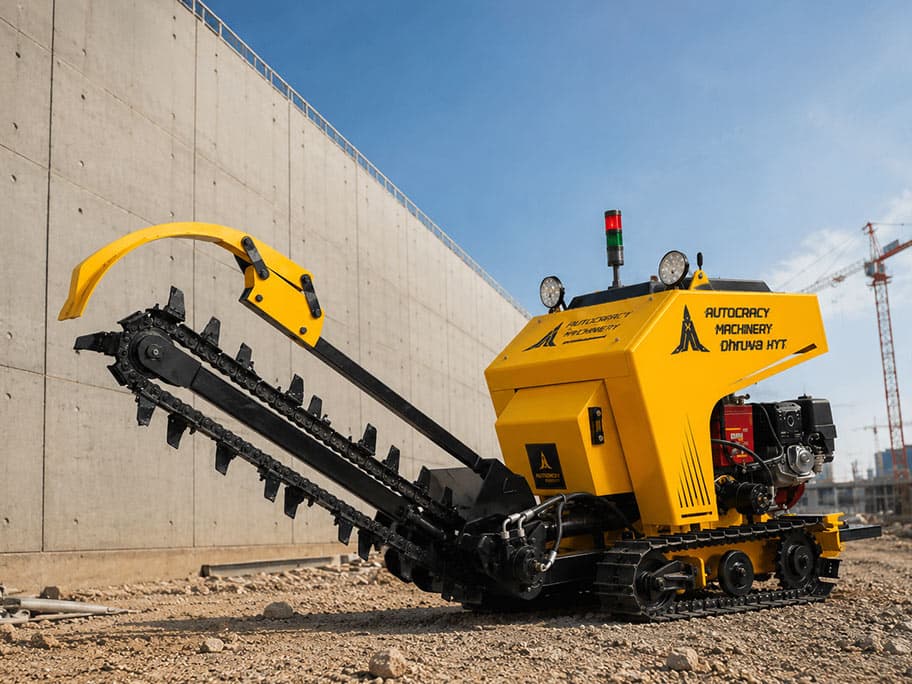
- | Equipment
600 mm
200 mm
4 stroke Petrol Engine
19.5
~30 to 60 m/hr
36 trs
5 Liters
Distributed solar installations, battery storage systems, and utility-scale renewable energy projects often require trenching operations in areas where access is restricted or space is limited. The Dhruva HYT Walk Behind Trencher is designed to support these environments by providing precise excavation capability within confined work zones, allowing infrastructure development without relying on larger trenching equipment. Its compact footprint makes it particularly suitable for solar projects involving narrow access routes, equipment clusters, and developed sites where maneuverability is essential.
The Dhruva HYT Compact Solar Trenching Machine supports underground installation of control cables, monitoring systems, low-voltage networks, and ancillary utility connections. By enabling accurate trench formation in constrained environments, the machine assists project teams in maintaining installation quality while reducing site disruption. This makes it a practical solution for solar developers seeking efficient infrastructure deployment in space-sensitive project locations.
PROJECT EXECUTION
Solar Energy
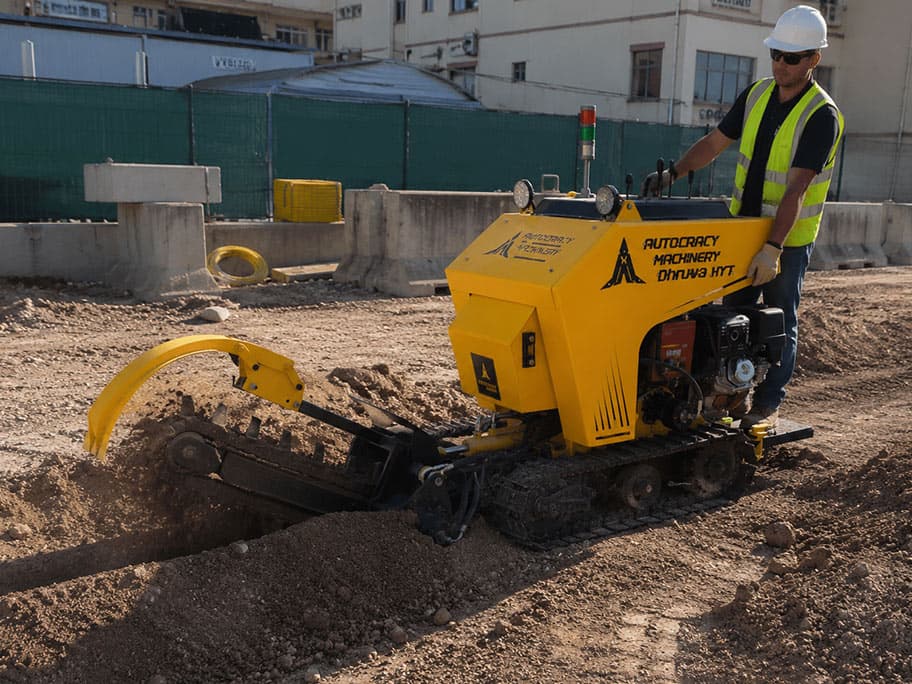
Renewable energy projects frequently require short-distance cable routes, equipment interconnections, and utility links that must be installed around existing structures and operational assets. These applications demand trenching equipment capable of working efficiently within compact corridors while maintaining route precision. The Dhruva HYT is well suited for these tasks due to its maneuverability and controlled excavation performance.
The Dhruva HYT Solar Cable Walk Behind Trencher is commonly used for inverter connections, monitoring infrastructure, battery storage integration, perimeter utility installations, and localized cable deployment. It also supports last-mile connectivity requirements where renewable energy systems must connect with nearby distribution assets or support infrastructure. Its ability to operate in confined project areas helps contractors maintain workflow efficiency while reducing the challenges associated with larger excavation machinery.
Solar Energy
Solar infrastructure projects require excavation solutions that support installation accuracy, efficient resource utilization, and minimal disruption to surrounding construction activities. In many renewable energy developments, trenching operations occur alongside electrical installation, commissioning, and civil works, making operational flexibility a key consideration. Equipment that can adapt to varying site constraints helps improve project coordination and supports efficient execution.
The Dhruva HYT Solar Installation Walk Behind Machine assists contractors in completing targeted trenching activities where precision and accessibility are important. Its compact operating profile enables excavation close to installed infrastructure, helping reduce unnecessary site disturbance while maintaining route consistency. For EPC contractors, engineering consultants, and project developers, this contributes to improved installation control and supports the efficient delivery of underground infrastructure required for modern solar energy facilities.
WORKFLOW
Map route requirements, trench depth, and site access before deploying Dhruva HYT.
Use the attachment setup to keep trench output consistent across solar park rows, inverter blocks, and power evacuation corridors.
Cleaner trench profiles help cable laying, earthing, backfilling, and commissioning teams proceed with less rework.
Autocracy Machinery can help match machine configuration, brochure details, and application guidance to the project.
APPLICATION SUPPORT
Share your site conditions, output goals, and timeline so the Autocracy team can guide model fit, brochure details, and next steps for your project.
Built for performance. Trusted by contractors, municipalities, and EPC teams across sectors.
| Feature | Value |
|---|---|
| Overall Length | 2400 mm |
| Overall Width | 900 mm |
| Overall Height | 1600 mm |
| Gross Weight | 600 kgs |
| Track Length | 1000 mm |
| Track Width | 150 mm |
Common questions about using Dhruva HYT in this application.
Industry model fit in Bolivia
For Solar Energy deployment on Bolivia project sites, Dhruva HYT is considered when a equipment must handle solar parks, cable corridors, pile rows, open sites, and long internal utility runs. The model should be reviewed against narrow-access trenching, compact service routes, and lighter utility work near finished areas, repeatable output, cable-route accuracy, panel-field access, and EPC schedule control, and the way crews hand work over after each pass.
The first comparison for Dhruva HYT should be array layout, cable depth, tracker clearance, soil profile, and commissioning milestones, because those factors usually decide field fit before horsepower, headline capacity, or attachment choice.
Dhruva HYT can support DC cable trenches, earthing routes, tracker support works, inverter corridors, and solar EPC utilities, depending on route condition, access, output target, operator workflow, and site support availability.
This model page is meant to support a more practical conversation about solar energy fit, brochure review, transport planning, deployment timing, and quote needs.
A better solar energy shortlist connects access width, turning room, target depth, spoil control, crew size, and transport between work fronts with solar parks, cable corridors, pile rows, open sites, and long internal utility runs, so Dhruva HYT is reviewed against the actual job sequence.
