Mayura TO for Defence Projects in Kuwait

OFC Deployment Machine

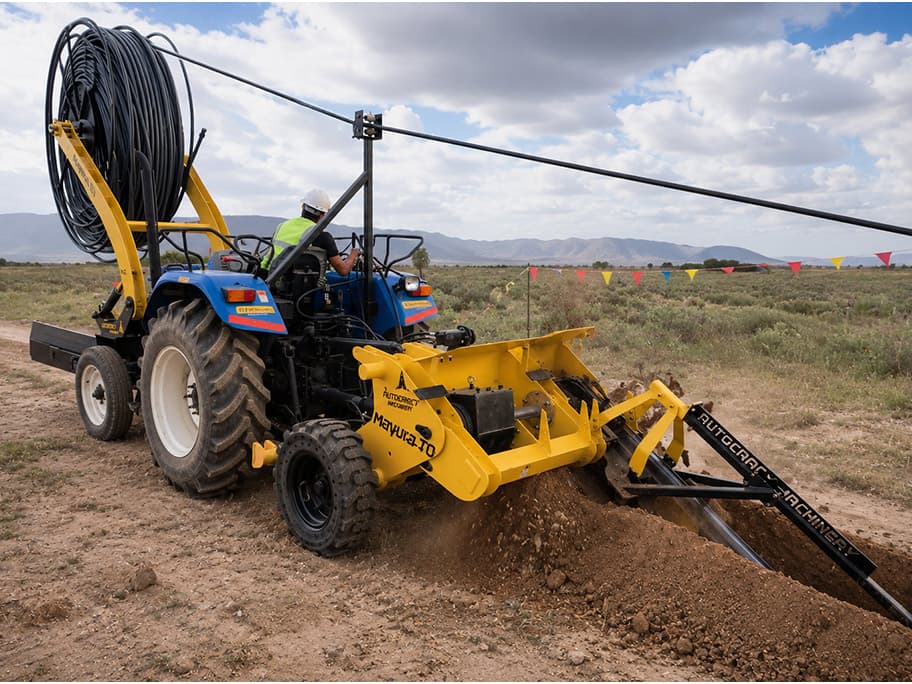
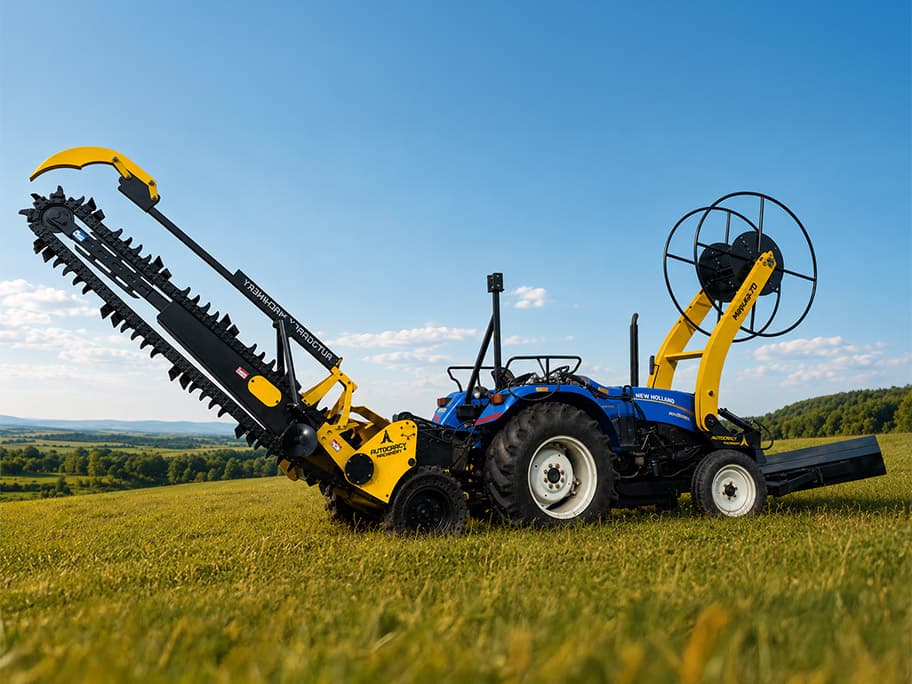
Mayura TO Military Utility Alignment Trencher

Mayura TO

- | Equipment

Support Vehicle

Tractor

Horsepower

>60 HP

Transmission Type

PTO / Hydraulic

Trenching Speed:

300 m/hr (150 m/hr in soft soil, 90 m/hr in hard soil)

Trench Width

110–280 mm

Trench Depth

Up to 1800 mm

Duct Diameter

30–60 mm

Defence Project Fit

The development of modern defence infrastructure requires secure underground utility systems capable of supporting communications, surveillance technologies, operational facilities, and future network expansion. The Mayura TO is engineered to support these requirements through a compact and efficient trenching process that minimizes surface disruption while enabling accurate underground installations.

As a Mayura TO Defence Trencher, the machine provides an effective solution for projects requiring continuous deployment of communication ducts, utility conduits, and fibre networks. Its one-pass operation that simplifies field execution by reducing the number of construction activities required along the installation route. This capability is particularly valuable for projects where site accessibility, deployment speed, and installation consistency are critical to successful infrastructure implementation.

FIELD PRIORITIES

  • One-pass trenching, duct installation, and reinstatement streamline corridor execution.
  • Narrow trench profile minimizes surface disturbance across sensitive defence sites.
  • Continuous duct deployment capability supports long-distance network installation efficiency.

PROJECT EXECUTION

How the Mayura TO fits the worksite

Defence

Use Case Applications - Defence, Utility Corridors & Last-Mile Connectivity

Defence organizations increasingly depend on underground connectivity networks that link command centers, logistics facilities, communications infrastructure, and support installations. The Mayura TO supports these projects by enabling efficient corridor development for fibre optic and utility distribution systems.

As a Mayura TO Military Infrastructure Trencher, the machine assists in establishing continuous underground routes that support secure data transmission, utility delivery, and operational connectivity. Its integrated duct installation capability allows infrastructure planners to streamline project execution while maintaining route integrity over extended distances. The machine is also suited for last-mile connectivity initiatives that require dependable underground infrastructure linking new facilities with existing defence utility networks.

Mayura TO Border Utility Trenching Machine

Defence

Execution Priorities for Defence

Infrastructure planners involved in defence projects must balance installation quality, deployment efficiency, and future scalability while managing complex construction environments. Underground utility projects require equipment capable of maintaining consistent output without creating unnecessary operational delays.

The Mayura TO Defence Logistics Route Machine contributes to these objectives by supporting continuous trenching and duct placement within a single work cycle. This integrated approach helps reduce project coordination challenges, minimizes site disturbance, and improves overall construction efficiency. By enabling streamlined underground utility installation, the machine supports infrastructure teams in maintaining schedule adherence, optimizing resource allocation, and delivering reliable utility corridors for long-term operational requirements.

WORKFLOW

From route planning to handoff

1

Route Planning

Map route requirements, trench depth, and site access before deploying Mayura TO.
2

Controlled Trenching

Use the attachment setup to keep trench output consistent across border infrastructure, camp utilities, and rugged access routes.

3

Installation Handoff

Cleaner trench profiles help utility placement, protection works, and field infrastructure teams proceed with less rework.

4

Support And Sizing

Autocracy Machinery can help match machine configuration, brochure details, and application guidance to the project.

APPLICATION SUPPORT

Need Mayura TO for Defence?

Share your site conditions, output goals, and timeline so the Autocracy team can guide model fit, brochure details, and next steps for your project.

Precision Machines. Project-Ready.

Built for performance. Trusted by contractors, municipalities, and EPC teams across sectors.

FeatureValue
ID of Duct roll (adjustable) 850 mm (adjustable)
Width of Duct Roll600 mm
OD of Duct rollUp to 2000 mm
Fuel Consumption Rate 5–6 L/hr
Max Backfilling Depth: 2000 mm
Max Blades Filling Width: 2500 mm
Min Blades Filling Width: 1000 mm
Overall Length: 10500 mm
Overall Width: 3200 mm
Overall Height: 4500 mm

Defence FAQs

Common questions about using Mayura TO in this application.

More Models in Mayura Series

| Attachment

Rudra 100XT Single chain Trencher for Defence
Trench Width110 - 280 mm
Trench DepthUpto 1200 mm
Drive Speed40 - 300 m/hr as per soil

| Attachment

Rudra 150XT Defence Utility Trencher
Trench Width110–280 mm
Trench DepthUp to 1800 mm
Drive Speed40 - 300 m/hr as per soil

| Attachment

Gaja 200XT Double Chain Trencher for Defence
Trench WidthUp to 600mm
Trench Depth1200mm-1500mm
Drive Speed40 - 300 m/hr as per soil

| Attachment

Gaja 300XC Military Utility Installation Trencher
Trench WidthUp to 900mm
Trench Depth1200mm-1500mm
Drive Speed40 - 300 m/hr as per soil

| Equipment

Mayura TW Trencher for Defence
Trench Width110–900 mm
Trench DepthUp to 1800 mm
Drive Speed40 - 300 m/hr as per soil

| Equipment

Gaja 400XC Heavy Duty Trencher for Defence
Trench WidthUp to 1200 mm
Trench Depth1200–1500 mm
Drive Speed40 - 300 m/hr as per soil

| Equipment

Mayura TL Trencher for Defence
Trench Width110-900 mm
Trench DepthUp to 1800 mm
Drive Speed40 - 300 m/hr as per soil

Mayura T | Equipment

Mayura T Trencher
Drive Speed40 - 300 m/hr as per soil

Industry model fit in Kuwait

Mayura TO for Defence in Kuwait

For Defence deployment on regional project sites, Mayura TO is considered when a equipment must handle remote work zones, restricted access areas, rugged terrain, and time-sensitive deployment sites. The model should be reviewed against route cutting, trench preparation, and utility corridor work where line accuracy matters, rugged reliability, transport readiness, field repairability, and predictable operation, and the way crews hand work over after each pass.

The first comparison for Mayura TO should be terrain type, access security, logistics, operator training, and rapid deployment windows, because those factors usually decide field fit before horsepower, headline capacity, or attachment choice.

Mayura TO can support camp utilities, boundary works, tactical infrastructure, drainage, and remote service routes, depending on route condition, access, output target, operator workflow, and site support availability.

This model page is meant to support a more practical conversation about defence fit, brochure review, transport planning, deployment timing, and quote needs.

A better defence shortlist connects trench depth, trench width, spoil handling, route crossings, surface reinstatement, and carrier fit with remote work zones, restricted access areas, rugged terrain, and time-sensitive deployment sites, so Mayura TO is reviewed against the actual job sequence.

Planning Guidance

Mayura TO for Defence in Kuwait should be reviewed as part of the full site workflow, not only as a standalone equipment listing. Buyers usually need to compare the required output, route length, working width, access condition, operator availability, and delivery timeline before selecting a machine for field deployment.

For Defence deployment on regional project sites, Mayura TO is considered when a equipment must handle remote work zones, restricted access areas, rugged terrain, and time-sensitive deployment sites. The model should be reviewed against route cutting, trench preparation, and utility corridor work where line accuracy matters, rugged reliability, transport readiness, field repairability, and predictable operation, and the way crews hand work over after each pass. This makes the page useful for early project planning, tender comparison, contractor discussions, and internal equipment shortlisting where teams need clear information before speaking with a supplier.

The first comparison for Mayura TO should be terrain type, access security, logistics, operator training, and rapid deployment windows, because those factors usually decide field fit before horsepower, headline capacity, or attachment choice. The same review should also include soil or surface condition, transport access, available carrier or tractor capacity, daily productivity expectation, service support, and the practical handoff between excavation, installation, backfilling, lifting, or finishing work.

Mayura TO can support camp utilities, boundary works, tactical infrastructure, drainage, and remote service routes, depending on route condition, access, output target, operator workflow, and site support availability. For infrastructure and utility projects, the equipment decision often affects crew size, fuel use, rework, route consistency, safety planning, and the number of machines required on site. A structured comparison helps avoid choosing a model only by headline specification.

This model page is meant to support a more practical conversation about defence fit, brochure review, transport planning, deployment timing, and quote needs. Autocracy Machinery pages are organised to help project owners, EPC teams, contractors, municipalities, utilities, agriculture teams, and site managers connect product capability with real operating conditions before requesting a quote or brochure.

When evaluating Mayura TO for Defence in Kuwait, teams can use the model information, media, specifications, application notes, and quote conversation together. This gives procurement and site teams a clearer basis for confirming fit, planning mobilisation, and preparing the next step with Autocracy Machinery.

A practical selection process also considers how the machine will move between work fronts, how operators will maintain output through the day, and how the surrounding crew will manage material handling, marking, inspection, and finishing work after the equipment completes its pass.

For many field projects, the right equipment choice is the one that balances specification, availability, maintenance access, and predictable output. Mayura TO for Defence in Kuwait should therefore be discussed with both procurement teams and site supervisors before finalising the requirement.

Project teams can prepare a stronger quote request by sharing route length, expected depth or working range, ground condition, preferred carrier, transport limits, daily target, and any special constraints such as narrow access, road-edge work, finished surfaces, utilities, or active public areas.

The content on this page is intended to support that discussion with enough context to compare options, understand the application fit, and decide whether a standard model, attachment configuration, brochure review, or direct consultation is the right next step.

Autocracy Machinery supports buyers who need equipment for trenching, pole installation, material handling, aquatic work, agricultural operations, landscaping, water management, solar EPC activity, telecom routes, defence infrastructure, and general construction requirements.

Before mobilisation, teams should confirm safety practices, operator familiarity, service support, spare availability, site preparation, and the handoff between machine output and downstream work. That final check helps keep deployment practical once the equipment reaches the project site.