


Route Planning
Map route requirements, trench depth, and site access before deploying Gaja 100XT.
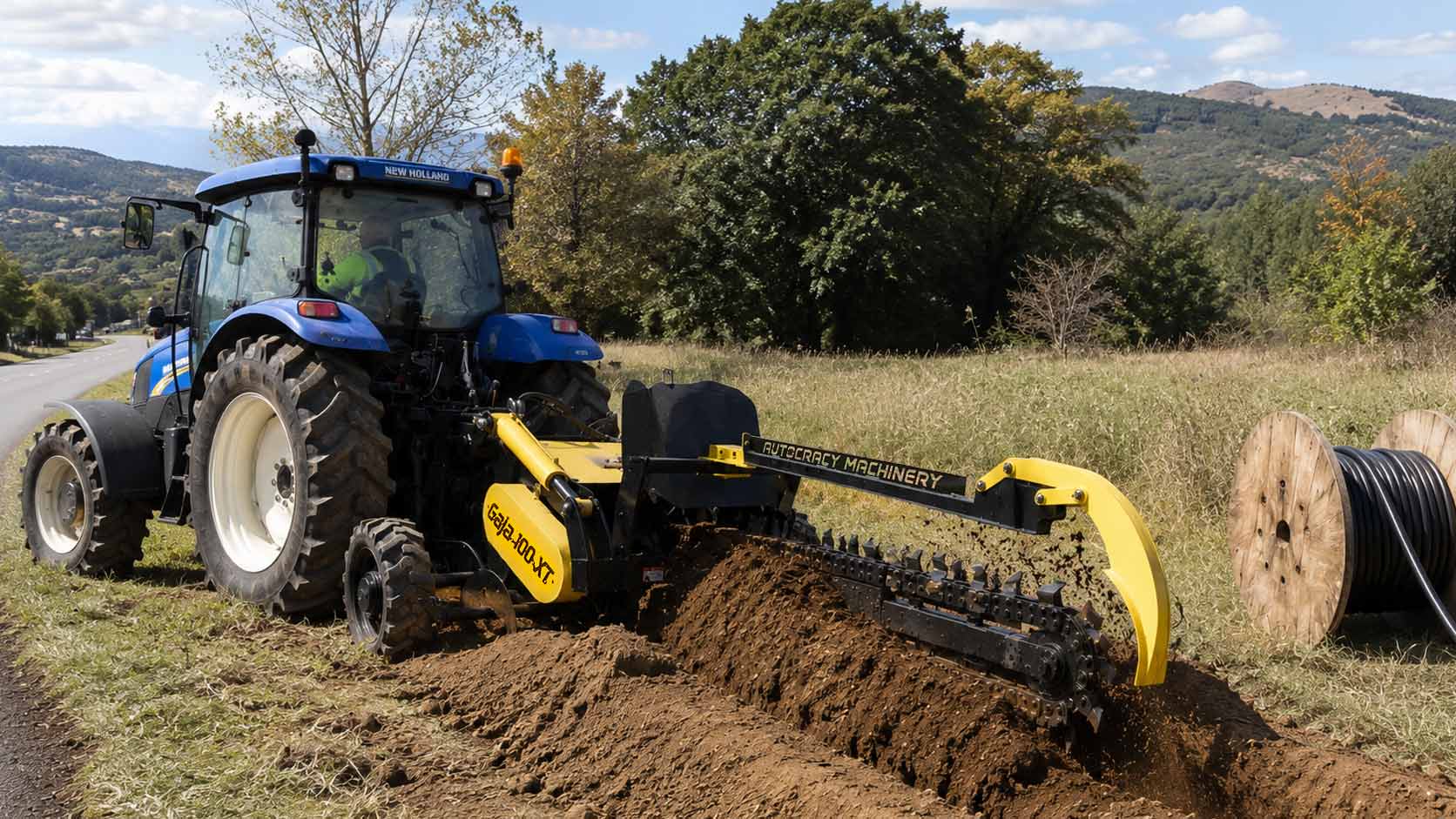
- | Attachment
Tractor
>60 HP
PTO / Hydraulic
200m/hr in soft soil, 150m/hr in hard soil
110-280 mm
1200-1500 mm
>25 lpm
The Gaja 100XT is purpose-built to meet the growing demands of high-speed digital infrastructure rollout, ensuring precise and continuous trenching for fiber deployment projects. As a Gaja 100XT Fiber Optic Cable Trencher, it delivers consistent trench geometry that supports safe cable placement in both urban and semi-urban environments. Its tractor-mounted design enables easy integration with standard agricultural tractors, allowing contractors to transition quickly between job sites without complex setup requirements. The machine is engineered to maintain stability across variable soil conditions, ensuring uninterrupted operations during long-distance backbone network installation. By reducing manual excavation dependency, it minimizes human error, enhances safety, and improves project turnaround time. The robust structure and controlled digging mechanism ensure minimal ground disturbance, making it highly suitable for modern telecom infrastructure development where precision and speed are equally critical.
PROJECT EXECUTION
OFC Telecommunications
The Gaja 100XT serves a wide range of infrastructure development needs, particularly in telecom and utility expansion projects where accuracy and consistency are essential. As a Gaja 100XT Telecom Utility Trencher, it supports efficient trenching for underground water pipelines, electrical conduits, drainage systems, and broadband connectivity networks. In OFC deployments, it plays a crucial role in last-mile connectivity by enabling controlled trench paths in congested urban layouts as well as open rural stretches. Its adaptable design allows contractors to execute multiple project types without switching equipment, improving operational efficiency. The machine performs effectively in utility corridor development where alignment precision and depth consistency are critical for long-term infrastructure reliability. This versatility makes it a preferred choice for EPC contractors and municipal bodies handling multi-utility installation projects, ensuring faster execution with reduced labor intensity and improved cost control across large-scale infrastructure programs.
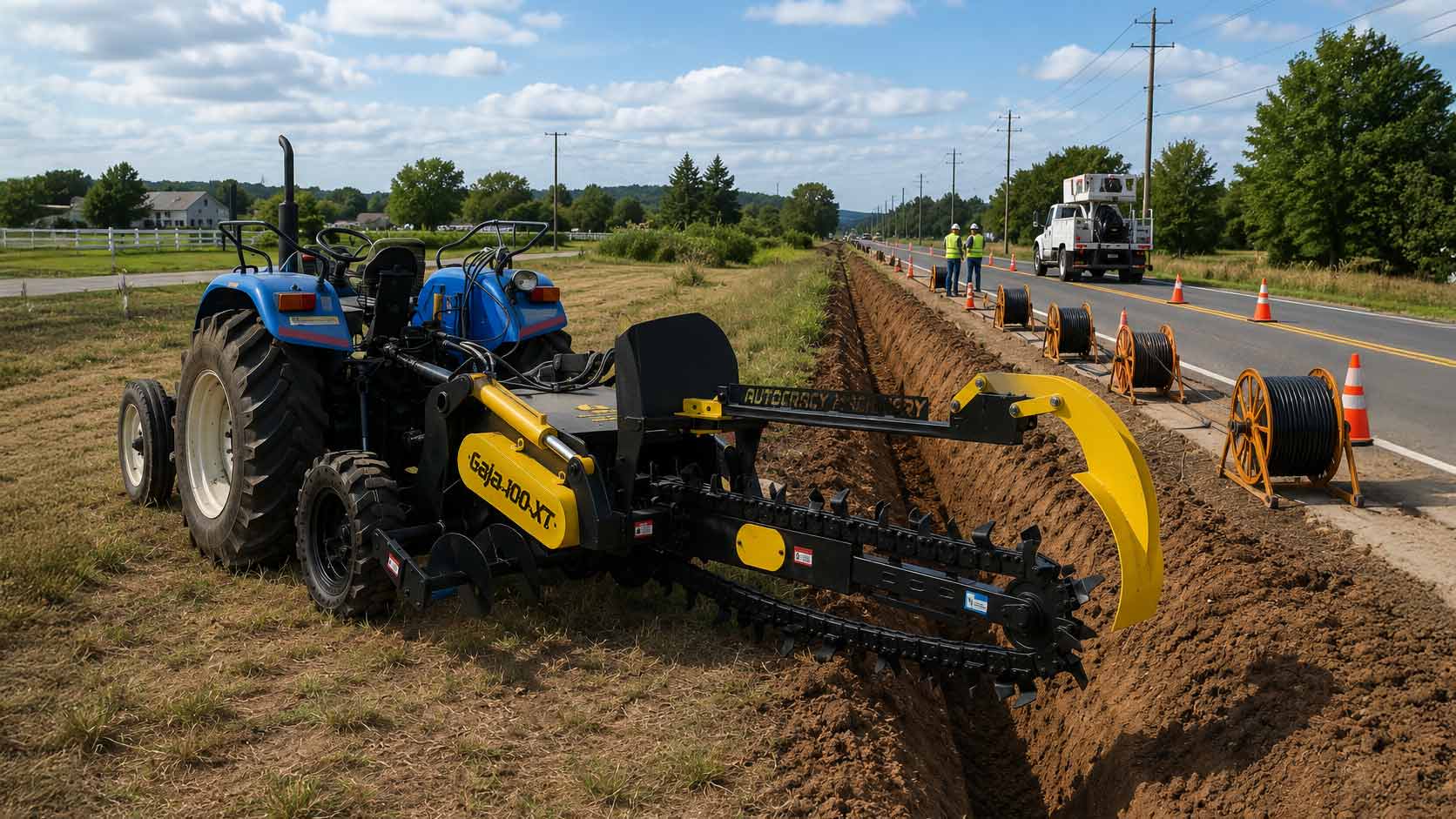
OFC Telecommunications
Efficient OFC deployment requires a balance of speed, accuracy, and minimal surface impact, and the Gaja 100XT is engineered to meet these execution priorities. As a Gaja 100XT OFC Cable Laying Trencher, it ensures uniform trench depth and width control, which is essential for protecting fiber integrity during and after installation. Priority is given to reducing rework by maintaining consistent trench profiles even in mixed soil conditions, helping contractors avoid costly delays. The machine also emphasizes operational efficiency by optimizing fuel usage and reducing dependency on manual labor, which is crucial for large-scale telecom rollout projects. Additionally, its stable hydraulic and PTO-driven system ensures smooth performance during continuous trenching operations. Supporting faster project completion timelines and minimizing surface restoration requirements enables telecom operators and EPC firms to scale infrastructure deployment efficiently.
WORKFLOW
Map route requirements, trench depth, and site access before deploying Gaja 100XT.
Use the attachment setup to keep trench output consistent across rural, semi-urban, and last-mile utility corridors.
Cleaner trench profiles help duct laying, cable pulling, jointing, and surface restoration teams proceed with less rework.
Autocracy Machinery can help match machine configuration, brochure details, and application guidance to the project.
APPLICATION SUPPORT
Share your site conditions, output goals, and timeline so the Autocracy team can guide model fit, brochure details, and next steps for your project.
Built for performance. Trusted by contractors, municipalities, and EPC teams across sectors.
| Feature | Value |
|---|---|
| Gross Weight | 2100kgs |
| Overall Length | 5.1 mts |
| Overall Width | 1.85 mts |
| Overall Height | 1.3 mts |
Common questions about using Gaja 100XT in this application.
| Attachment

Industry model fit in Kuwait
Gaja 100XT is listed here for project teams in Kuwait planning ofc telecommunications work with trenchers. Selection should come down to carrier fit, operating method, right-of-way, duct depth, spoil handling, traffic interface, and crew sequencing, and whether the machine supports route accuracy, cable protection, trench consistency, and kilometre-level productivity.
For OFC Telecommunications work, compare Gaja 100XT against right-of-way, duct depth, spoil handling, traffic interface, and crew sequencing before finalising equipment deployment, because these details decide whether the machine fits the route, access, and daily output target.
Gaja 100XT may suit OFC cable laying, telecom ducts, utility corridors, broadband rollout, and city network expansion when access, output goals, support arrangements, and follow-on crews line up with the job.
Use the page to move from specification review into a clearer discussion about ofc telecommunications suitability, brochure details, field support, and quotation requirements.
For trenchers, check trench depth, trench width, spoil handling, route crossings, surface reinstatement, and carrier fit together with road shoulders, urban corridors, utility crossings, and long linear cable routes; this helps separate a suitable ofc telecommunications setup from a generic model match.


