


Route Planning
Map route requirements, trench depth, and site access before deploying Dhruva HYT.
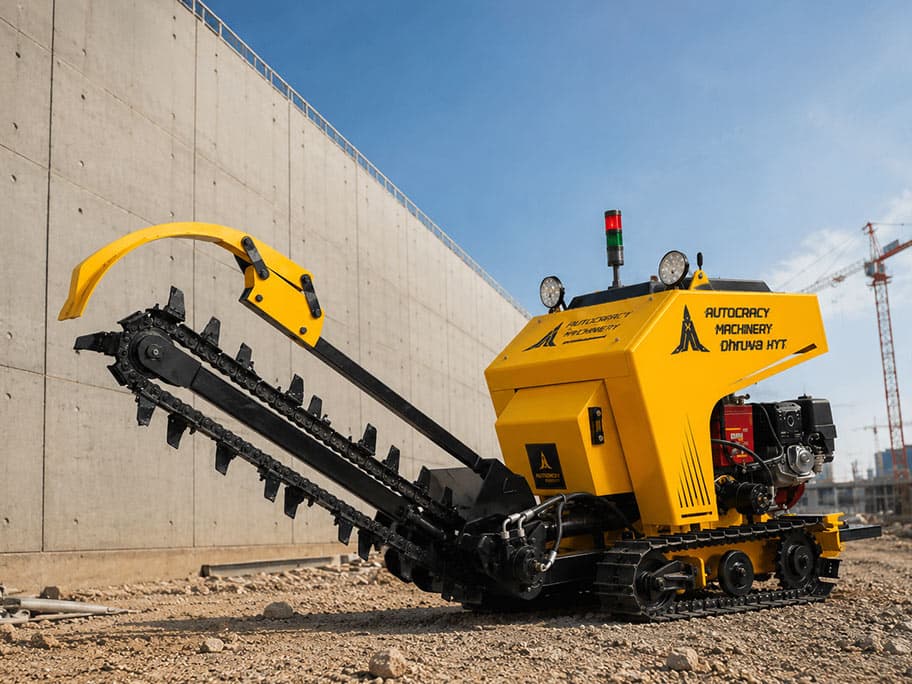
- | Equipment
600 mm
200 mm
4 stroke Petrol Engine
19.5
~30 to 60 m/hr
36 trs
5 Liters
Effective water management infrastructure often depends on the ability to install underground networks in locations where access constraints, terrain conditions, and existing assets create construction challenges. The Dhruva HYT Walk Behind Trencher is developed to support these requirements through accurate trench excavation for water conveyance systems, irrigation pipelines, drainage upgrades, and utility service connections. Its compact design enables operators to work in confined project environments while maintaining excavation consistency and installation quality.
The Dhruva HYT Water Management Walk Behind Trencher is particularly suited for projects involving network extensions, asset rehabilitation, and decentralized water distribution systems. Whether supporting agricultural water delivery, municipal infrastructure improvements, or localized utility installations, the machine provides a practical trenching solution where maneuverability, trench precision, and reduced site disturbance are important considerations throughout project execution.
PROJECT EXECUTION
Water Management
Water infrastructure projects frequently involve complex installation environments where underground services must be deployed alongside existing assets and operational facilities. The Dhruva HYT Walk Behind Trencher supports trench construction for water supply pipelines, field distribution systems, drainage improvements, and utility service routes. Its compact tracked configuration allows efficient movement across uneven terrain, cultivated land, and restricted-access work zones.
For corridor-based infrastructure development, the Dhruva HYT Utility Corridor Walk Behind Trencher supports excavation activities alongside canals, watercourses, irrigation channels, and utility routes where precise trench alignment is required. The machine is also suitable for last-mile connectivity programs that extend water services to remote users, agricultural facilities, and newly developed infrastructure areas. Its controlled excavation capability helps maintain installation accuracy while reducing disruption to surrounding operations and landscapes.
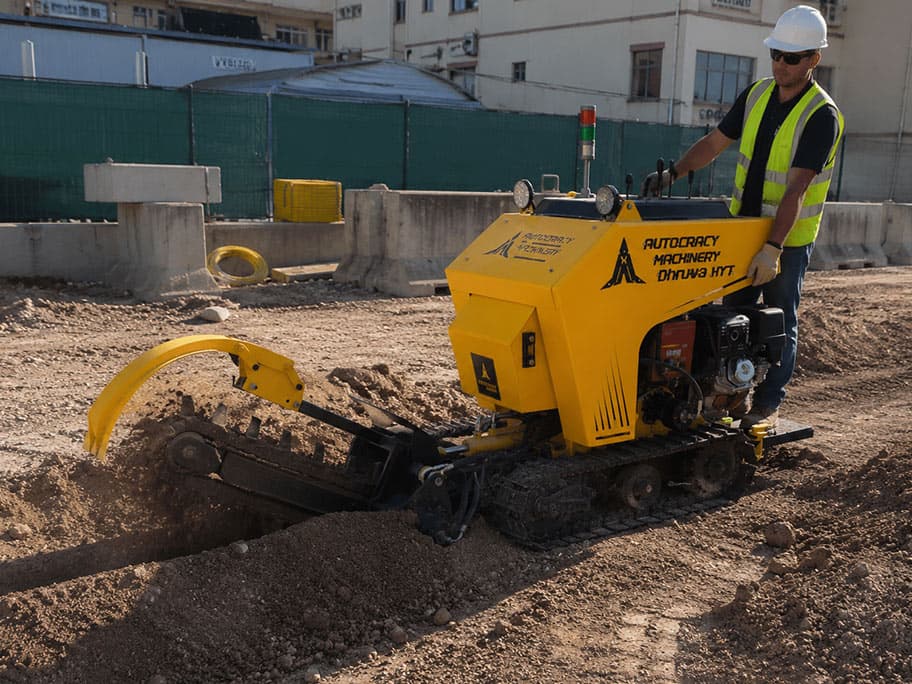
Water Management
Delivering successful water management projects requires balancing construction efficiency with installation accuracy and long-term infrastructure performance. Project teams often focus on maintaining trench uniformity, preserving surrounding assets, managing spoil effectively, and ensuring safe working practices within constrained project environments. The Dhruva HYT Walk Behind Trencher supports these objectives by enabling controlled excavation with predictable trench profiles and consistent operational performance.
In drainage modernization and water transfer projects, the Dhruva HYT Drainage Trenching Walk Behind Machine provides an effective solution for creating trenches in locations where access limitations can affect construction productivity. Its compact dimensions and hydraulic trenching system allow operators to perform excavation activities with greater control, supporting efficient installation workflows while helping contractors manage project schedules, resource utilization, and construction quality requirements.
WORKFLOW
Map route requirements, trench depth, and site access before deploying Dhruva HYT.
Use the attachment setup to keep trench output consistent across rural pipeline routes, municipal utility lines, and field irrigation networks.
Cleaner trench profiles help pipe laying, jointing, testing, and backfilling teams proceed with less rework.
Autocracy Machinery can help match machine configuration, brochure details, and application guidance to the project.
APPLICATION SUPPORT
Share your site conditions, output goals, and timeline so the Autocracy team can guide model fit, brochure details, and next steps for your project.
Built for performance. Trusted by contractors, municipalities, and EPC teams across sectors.
| Feature | Value |
|---|---|
| Overall Length | 2400 mm |
| Overall Width | 900 mm |
| Overall Height | 1600 mm |
| Gross Weight | 600 kgs |
| Track Length | 1000 mm |
| Track Width | 150 mm |
Common questions about using Dhruva HYT in this application.
Industry model fit in Qatar
For Water Management deployment on Qatar project sites, Dhruva HYT is considered when a equipment must handle canal edges, drainage alignments, wet soil pockets, and rural or municipal water routes. The model should be reviewed against narrow-access trenching, compact service routes, and lighter utility work near finished areas, water flow continuity, depth consistency, soil handling, and low rework, and the way crews hand work over after each pass.
The first comparison for Dhruva HYT should be gradient, water table, spoil placement, pipe depth, and monsoon-season access, because those factors usually decide field fit before horsepower, headline capacity, or attachment choice.
Dhruva HYT can support drainage, irrigation channels, pipeline routes, desilting support, and water distribution works, depending on route condition, access, output target, operator workflow, and site support availability.
This model page is meant to support a more practical conversation about water management fit, brochure review, transport planning, deployment timing, and quote needs.
A better water management shortlist connects access width, turning room, target depth, spoil control, crew size, and transport between work fronts with canal edges, drainage alignments, wet soil pockets, and rural or municipal water routes, so Dhruva HYT is reviewed against the actual job sequence.
