Specifications and Applications in Kuwait

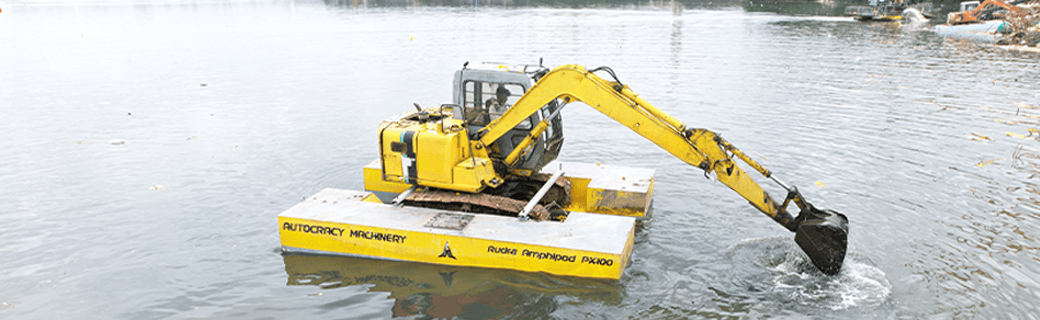
RudraRudra Amphipod PX100 Floating Work Platform
Digging Reach

5300 mm
Working Depth

3150 mm

Swing Radius

5500 mm

Barges / Floating Pontoon

Rudra Amphipod PX100

Equipment

Overview

Floating Pontoon Excavator - A Reliable Solution for River, Canal & Lakes - Rudra Amphipod

The Rudra Amphipod is a next-generation floating pontoon excavator designed for superior performance in dredging, desilting, and aquatic vegetation removal across shallow to medium-depth water bodies. Engineered with dual corrosion-protected pontoons, a robust cross-beam structure, and a modular mounting system, it provides exceptional stability on both land and water. The Amphipod ensures safe excavator installation, adaptability to site conditions, and reliable operation for extended duty cycles. Built to ISO/CE fabrication standards, it delivers unmatched durability while supporting efficient, eco-friendly water restoration and flood mitigation projects.

Precision Machines. Project-Ready.

Built for performance. Trusted by contractors, municipalities, and EPC teams across sectors.

Digging Reach

5300 mm

Working Depth

3150 mm

Swing Radius

5500 mm

Working Height

7800 mm

Dumping Height

6070 mm

Gross Weight

3.7 ton

Overall Length

5530 mm

Overall Width

3500 mm

Overall Height

1250 mm

Overall Dimensions

4300*2300-2550*3300

Key Features

Discover what makes the Rudra Amphipod PX100 stand out from the competition

Digging Reach

5300 mm digging reach capability helps Rudra Amphipod PX100 support practical barges / floating pontoon work with controlled output, dependable operation, and smoother field execution.

Working Depth

3150 mm working depth capability helps Rudra Amphipod PX100 support practical barges / floating pontoon work with controlled output, dependable operation, and smoother field execution.

Swing Radius

5500 mm swing radius capability helps Rudra Amphipod PX100 support practical barges / floating pontoon work with controlled output, dependable operation, and smoother field execution.

Working Height

7800 mm working height capability helps Rudra Amphipod PX100 support practical barges / floating pontoon work with controlled output, dependable operation, and smoother field execution.

Dumping Height

6070 mm dumping height capability helps Rudra Amphipod PX100 support practical barges / floating pontoon work with controlled output, dependable operation, and smoother field execution.

Gross Weight

3.7 ton gross weight capability helps Rudra Amphipod PX100 support practical barges / floating pontoon work with controlled output, dependable operation, and smoother field execution.

BEST SUITED FOR INDUSTRIES

Rudra Amphipod PX100 fits demanding barges / floating pontoon applications

Match Rudra Amphipod PX100 with industry use cases where equipment reliability, field output, and site readiness matter most.

01

Rudra Amphipod PX100 is suited for environmental sustainability teams that need dependable barges / floating pontoon performance, cleaner site execution, and faster project handoff.

Rudra Amphipod PX100 is suited for environmental sustainability teams that need dependable barges / floating pontoon performance, cleaner site execution, and faster project handoff.

02

Rudra Amphipod PX100 is suited for ofc telecommunications teams that need dependable barges / floating pontoon performance, cleaner site execution, and faster project handoff.

Rudra Amphipod PX100 is suited for ofc telecommunications teams that need dependable barges / floating pontoon performance, cleaner site execution, and faster project handoff.

03

Rudra Amphipod PX100 is suited for water management teams that need dependable barges / floating pontoon performance, cleaner site execution, and faster project handoff.

Rudra Amphipod PX100 is suited for water management teams that need dependable barges / floating pontoon performance, cleaner site execution, and faster project handoff.

04

Rudra Amphipod PX100 is suited for agriculture teams that need dependable barges / floating pontoon performance, cleaner site execution, and faster project handoff.

Rudra Amphipod PX100 is suited for agriculture teams that need dependable barges / floating pontoon performance, cleaner site execution, and faster project handoff.

05

Rudra Amphipod PX100 is suited for construction teams that need dependable barges / floating pontoon performance, cleaner site execution, and faster project handoff.

Rudra Amphipod PX100 is suited for construction teams that need dependable barges / floating pontoon performance, cleaner site execution, and faster project handoff.

06

Rudra Amphipod PX100 is suited for solar energy teams that need dependable barges / floating pontoon performance, cleaner site execution, and faster project handoff.

Rudra Amphipod PX100 is suited for solar energy teams that need dependable barges / floating pontoon performance, cleaner site execution, and faster project handoff.

PRODUCT FIT

Rudra Amphipod PX100 for practical barges / floating pontoon work

Understand how Rudra Amphipod PX100 fits project planning, field deployment, and daily operating priorities.

Project Applications

Rudra Amphipod PX100 supports barges / floating pontoon work across utility routes, rural sites, and practical field conditions where consistent machine output matters.

Site Planning

5300 mm digging reach helps teams plan equipment fit, route preparation, and day-to-day execution before deployment.

Fleet Fit

Rudra Amphipod PX100 is configured as a equipment, helping contractors and operators understand how it fits with existing fleet resources and site workflows.

Operational Value

3150 mm working depth supports controlled operation, while 5500 mm swing radius helps improve project predictability.

More Models in Barges / Floating Pontoon

| Attachment

Rudra 100 Trencher Machine
Trench Width150–280 mm
Trench DepthUp to 1000 mm
Drive Speed40 - 300 m/hr as per soil

| Attachment

Rudra 100XT Single chain Trencher for Solar Energy
Trench Width110 - 280 mm
Trench DepthUpto 1200 mm
Drive Speed40 - 300 m/hr as per soil

| Attachment

Rudra 150XT OFC Telecommunications Trencher
Trench Width110–280 mm
Trench DepthUp to 1800 mm
Drive Speed40 - 300 m/hr as per soil

| Equipment

Rudra Aquamax 100X Floating Trash Skimmer
Storage Capacity<8M³
Load CapacityUp to 3 Tonnes
Total Machine Weight≤ 8.5 Tonnes

| Equipment

Rudra Aquamax 150X Environmental Sustainable Floating Trash Collector
Support PlatformCatamaran Hull
Collection Width & Depth4.5 m width × Upto 1.5 m depth below waterline
Drive SystemPaddle Wheel

Self Propelled Multi Utility Machine | Equipment

portable trencher
Support VehicleSelf-Propelled
Engine TypeDiesel
Horsepower25 HP (18.8 kW)

Amphibious Excavator | Equipment

Amphibious Excavator, Floating Excavator, Excavator for flood
Operating Weight0–5 ton

| Equipment

Rudra Amphipod PX100 Floating Pontoon
Digging Reach5300 mm
Working Depth3150 mm
Swing Radius5500 mm

| Attachment

Rudra 100T Utility Trencher
Trench Width110 - 280 mm
Trench Depthupto 1200 mm
Drive Speed40 - 300 m/hr as per soil

Rudra Prime Pro | Equipment

Rudra Prime Pro

Rudra Amphimax 250EX | Equipment

Rudra Amphimax 250EX
Operating Weight38 tons

Rudra Aqua Boat | Equipment

Rudra Aqua Boat

Rudra Amphimax 100EX | Equipment

Amphibious Excavator, Floating Excavator, Excavator for flood
Operating Weight6–10 ton

| Equipment

Rudra Aquamax 160X Environmental Sustainable Floating Trash Collector
Support PlatformCatamaran Hull
Collection Width & Depth4.5 m width × Upto 1.5 m depth below waterline
Drive SystemPaddle Wheel

Frequently Asked Questions

Common questions about Rudra Amphipod PX100 specifications, applications, and project fit.

Floating Pontoon Platform

Need Assistance with Barges / Floating Pontoon?

Model details in Kuwait

Rudra Amphipod PX100 for Kuwait project execution

Rudra Amphipod PX100 is listed for Kuwait buyers who need to compare machine capability, applications, specifications, and quote readiness for practical field deployment.

can be evaluated by working capability, brochure information, media, and site suitability.

Use this page to review Rudra Amphipod PX100 around dry ground, service routes, equipment mobilisation, route clearance, working width, and output targets.

export-ready equipment guidance, specification review, brochure requests, and Kuwait quote planning

Planning Guidance

Rudra Amphipod PX100 for Kuwait project execution should be reviewed as part of the full site workflow, not only as a standalone equipment listing. Buyers usually need to compare the required output, route length, working width, access condition, operator availability, and delivery timeline before selecting a machine for field deployment.

Rudra Amphipod PX100 is listed for Kuwait buyers who need to compare machine capability, applications, specifications, and quote readiness for practical field deployment. This makes the page useful for early project planning, tender comparison, contractor discussions, and internal equipment shortlisting where teams need clear information before speaking with a supplier.

can be evaluated by working capability, brochure information, media, and site suitability. The same review should also include soil or surface condition, transport access, available carrier or tractor capacity, daily productivity expectation, service support, and the practical handoff between excavation, installation, backfilling, lifting, or finishing work.

Use this page to review Rudra Amphipod PX100 around dry ground, service routes, equipment mobilisation, route clearance, working width, and output targets. For infrastructure and utility projects, the equipment decision often affects crew size, fuel use, rework, route consistency, safety planning, and the number of machines required on site. A structured comparison helps avoid choosing a model only by headline specification.

export-ready equipment guidance, specification review, brochure requests, and Kuwait quote planning Autocracy Machinery pages are organised to help project owners, EPC teams, contractors, municipalities, utilities, agriculture teams, and site managers connect product capability with real operating conditions before requesting a quote or brochure.

When evaluating Rudra Amphipod PX100 for Kuwait project execution, teams can use the model information, media, specifications, application notes, and quote conversation together. This gives procurement and site teams a clearer basis for confirming fit, planning mobilisation, and preparing the next step with Autocracy Machinery.

A practical selection process also considers how the machine will move between work fronts, how operators will maintain output through the day, and how the surrounding crew will manage material handling, marking, inspection, and finishing work after the equipment completes its pass.

For many field projects, the right equipment choice is the one that balances specification, availability, maintenance access, and predictable output. Rudra Amphipod PX100 for Kuwait project execution should therefore be discussed with both procurement teams and site supervisors before finalising the requirement.

Project teams can prepare a stronger quote request by sharing route length, expected depth or working range, ground condition, preferred carrier, transport limits, daily target, and any special constraints such as narrow access, road-edge work, finished surfaces, utilities, or active public areas.

The content on this page is intended to support that discussion with enough context to compare options, understand the application fit, and decide whether a standard model, attachment configuration, brochure review, or direct consultation is the right next step.

Autocracy Machinery supports buyers who need equipment for trenching, pole installation, material handling, aquatic work, agricultural operations, landscaping, water management, solar EPC activity, telecom routes, defence infrastructure, and general construction requirements.

Before mobilisation, teams should confirm safety practices, operator familiarity, service support, spare availability, site preparation, and the handoff between machine output and downstream work. That final check helps keep deployment practical once the equipment reaches the project site.