


Support Vehicle
Tractor
Tractor
2400 mm
850 mm
Tractor Attachments
Attachment
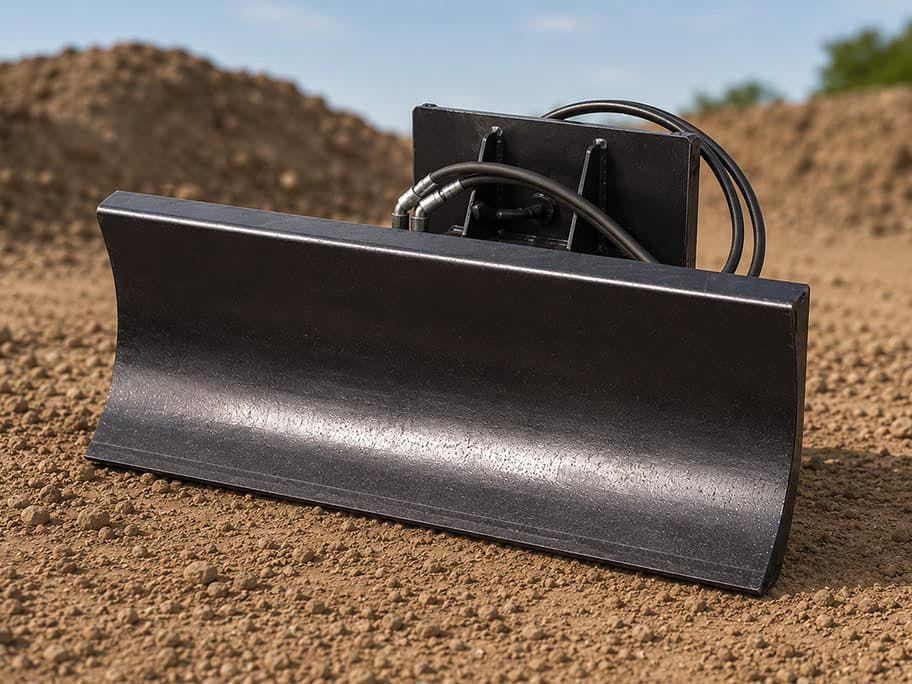
The Dozer Single Blade is a heavy-duty tractor-mounted attachment engineered for grading, land leveling, trench backfilling, and controlled soil movement across infrastructure, utility, and agricultural projects. Designed with a robust moldboard structure and hardened boron steel cutting edge, the attachment delivers reliable performance in demanding Indian operating conditions. With a 2400 mm blade width and approximately 1.0 m³ blade capacity, it enables efficient spreading, pushing, and leveling of excavated material over large work areas.
This Single Blade Dozer attachment is widely used in road construction, irrigation projects, pipeline installation, drainage works, canal embankment shaping, and utility corridor restoration. The primary purpose of the attachment is to simplify ground preparation and accelerate post-excavation restoration activities by enabling fast and controlled backfilling, grading, and surface finishing operations. Its 4-way blade functionality allows operators to perform directional soil movement and accurate site leveling with improved operational efficiency.
Built for tractors above 75 HP, the Dozer Single Blade attachment integrates easily with existing tractor fleets, reducing the need for separate earthmoving equipment. It helps contractors, infrastructure developers, and agricultural operators improve productivity while lowering fuel consumption, manpower requirements, and overall project execution costs.
Built for performance. Trusted by contractors, municipalities, and EPC teams across sectors.
Tractor
2400 mm
850 mm
10 mm
20 mm
Approx. 1.0 m³
Above 75 HP
Discover what makes the Dozer Single Blade stand out from the competition
The 2400 mm wide blade supports efficient grading, trench backfilling, and surface leveling across large agricultural fields and construction work areas.
Approximately 1.0 m³ blade capacity enables effective movement, spreading, and leveling of soil, gravel, and excavated material during land development and site preparation activities.
The curved moldboard design enhances soil flow and rolling efficiency, ensuring smoother grading performance and improved backfilling operations.
The single-blade 4-way operational design enables accurate soil pushing, directional grading, and controlled leveling for precise ground finishing applications.
Engineered for tractors above 90 HP, the attachment delivers reliable grading, leveling, and backfilling performance across agricultural and construction projects.
Approx. 1.0 m³ blade capacity capability helps Dozer Single Blade support practical tractor attachments work with controlled output, dependable operation, and smoother field execution.
BEST SUITED FOR INDUSTRIES
Match Dozer Single Blade with industry use cases where equipment reliability, field output, and site readiness matter most.
The Dozer Single Blade is used for site grading, land leveling, trench backfilling, and surface restoration. It improves project efficiency by enabling fast material movement, accurate finishing, and reduced equipment dependency.
The Dozer Single Blade is used for field leveling, bund formation, soil spreading, irrigation channel shaping, and land preparation. It enhances field productivity through efficient earthmoving, uniform land grading, and lower operating costs.
PRODUCT FIT
Understand how Dozer Single Blade fits project planning, field deployment, and daily operating priorities.
The Dozer Blade is suitable for agriculture and construction projects, supporting trench backfilling, land leveling, soil spreading, surface grading, site preparation, and restoration activities following excavation works.
Compatible with tractors above 90 HP, the machine enables efficient planning and execution of grading, leveling, and backfilling operations across farms, construction sites, and utility corridors.
Integrates seamlessly with existing tractor fleets, allowing operators to perform earthmoving, grading, and restoration tasks using a single tractor-mounted attachment instead of multiple machines.
Delivers efficient backfilling and surface grading performance, reducing equipment requirements, fuel consumption, manpower dependency, and operational costs while improving overall project productivity and site efficiency.
Common questions about Dozer Single Blade specifications, applications, and project fit.
Model details in Kuwait
Dozer Single Blade is listed for Kuwait buyers who need to compare machine capability, applications, specifications, and quote readiness for practical field deployment.
Dozer Single Blade
Use this page to review Dozer Single Blade around dry ground, service routes, equipment mobilisation, route clearance, working width, and output targets.
export-ready equipment guidance, specification review, brochure requests, and Kuwait quote planning


