Modern infrastructure depends on systems that often remain invisible once a project is completed. Power transmission, renewable energy, communication networks, pipelines, utilities, and defence infrastructure all require properly prepared underground routes before installation can begin.
As project routes become longer and trench requirements become deeper and wider, excavation becomes more demanding. Changing soil conditions, extensive work areas, trench profile requirements, and the management of excavated material can all influence productivity.
Conventional excavation methods may be suitable for smaller or general-purpose digging requirements, but large linear trenching projects require a more specialized approach.
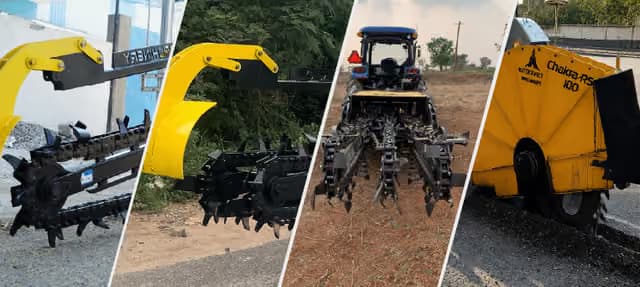
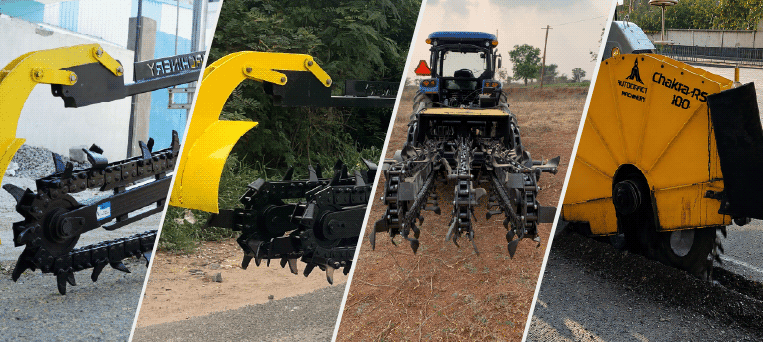
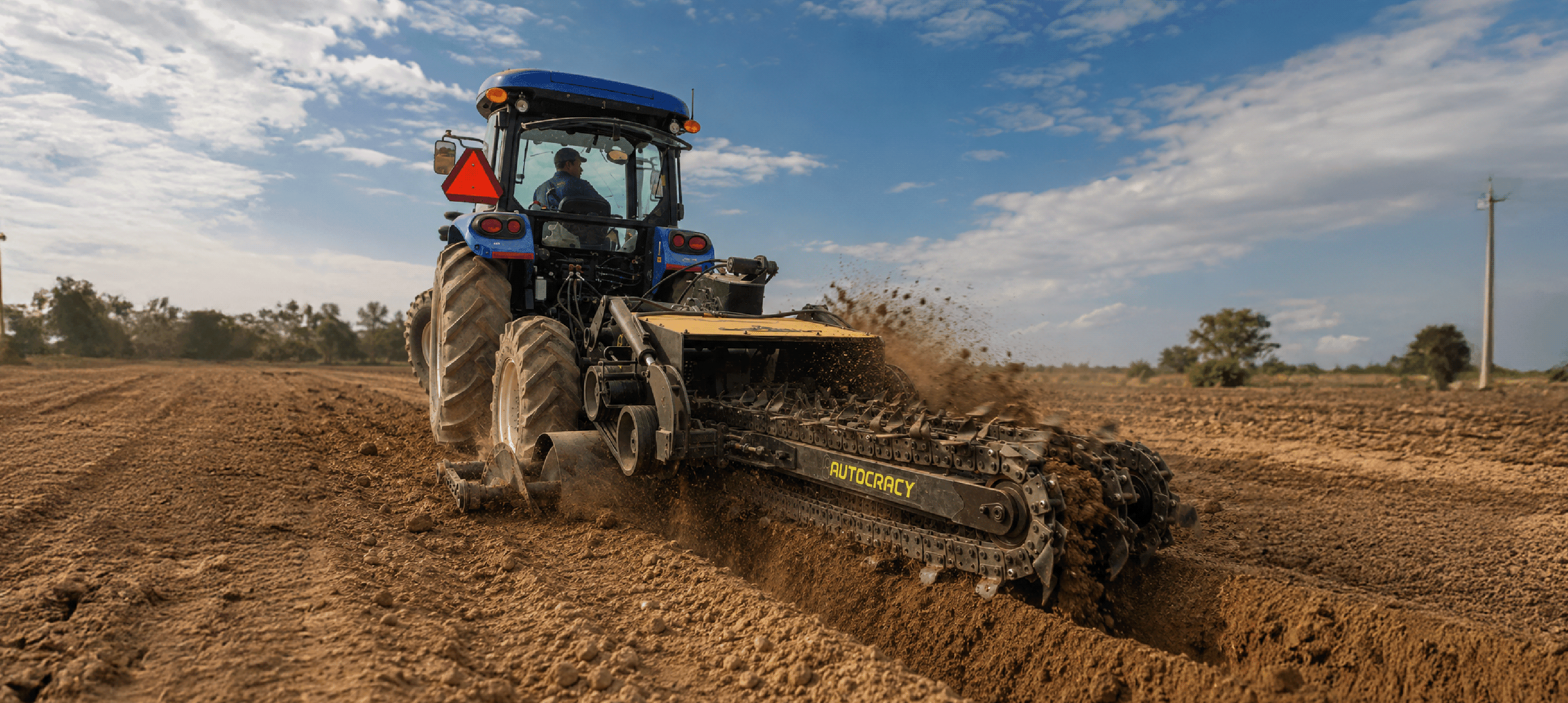
The Gaja 300XC trenching machine is developed for this requirement. It is a heavy-duty tractor-mounted trencher designed for tractors.
A large trenching project is not simply about removing soil from the ground. The excavation has to follow the required route and maintain the necessary depth and width while the machine continues working across changing ground conditions.
Using general-purpose excavation equipment can involve repeated positioning, wider-than-required excavation, additional material handling, and greater coordination between machines.
A dedicated trencher approaches the work differently.
The Gaja 300XC trench digging machine is designed specifically around continuous trench excavation.This makes it particularly relevant for projects where trenching extends across long routes and excavation is a major part of the overall construction workflow.
Long-distance trenching introduces another challenge: maintaining the required excavation profile across the entire route.
Soil conditions can change from one section to another. Soft soil, harder ground, moisture, terrain variations, and tractor configuration can all influence actual trenching performance.
The Gaja 300XC is designed to work across varying soil conditions, with actual productivity depending on the ground and operating environment.
This gives project teams a mechanized solution that can be planned around the expected site conditions rather than relying entirely on manual excavation or general-purpose equipment.
Removing soil is only one part of trenching.
Once excavation begins, the material removed from the trench needs to be positioned so that it does not unnecessarily obstruct movement, installation activities, or the remaining work corridor.
The Gaja 300XC incorporates a dual conveyor arrangement, consisting of a fixed conveyor and a tilting conveyor. The system helps move excavated material away from the trench and allows the spoil to be directed toward the required side.
This can help maintain a more organized trenching corridor and reduce repeated manual handling of excavated soil.
On long infrastructure routes, better spoil management can contribute to a smoother transition between excavation and subsequent installation activities.
The machine's excavation capacity makes it suitable for several infrastructure applications where deeper and wider trench profiles are required.
Solar and wind energy projects often involve extensive underground cable routes.
Solar power plants require underground connections between electrical equipment, collection systems, transformers, and substations. Wind farms similarly require underground connections between turbines and electrical infrastructure.
The Gaja 300XC can support these applications by providing the trenching capacity needed for long underground cable routes.
Power transmission and distribution projects can require substantial underground corridors for cable installation.
Where project specifications call for deeper or wider excavation, the Gaja 300XC provides a dedicated trenching solution capable of producing a trench up to 1500 mm deep and 900 mm wide.
Defence infrastructure can involve underground communication networks, power systems, utility routes, and other critical installations.
These projects may extend across large areas and can involve demanding terrain and excavation requirements. A high-capacity tractor-mounted trencher can provide a practical solution where continuous and substantial trenching is required.
Underground optical fiber and communication infrastructure require carefully prepared cable routes.
For larger OFC projects where greater trench depth and width are required, the Gaja 300XC can provide a dedicated excavation solution while helping manage excavated material during continuous trenching.
Water pipelines, utility corridors, drainage infrastructure, and other linear projects often require excavation across considerable distances.
The Gaja 300XC can be used where project requirements call for deeper and wider trenches and where continuous excavation and spoil management are important to overall site execution.
Conventional excavation equipment such as excavators and backhoe loaders is designed to perform a wide range of general excavation activities. That versatility is valuable, but it does not necessarily make them the most efficient choice for every long-distance trenching application.
The advantage is therefore not simply that the machine digs. It is that the machine is designed specifically around the workflow of large-scale trenching.
When a project uses equipment that is not suited to its trenching requirements, the limitations can extend beyond excavation itself.
General-purpose machines may require repeated positioning and multiple excavation cycles to achieve the required trench profile. Over long routes, these additional movements can increase overall project time.
When excavated material is not moved efficiently away from the trench, additional labour or equipment may be required to clear the working area.
Maintaining a uniform depth and width can become more difficult when trenching is carried out manually or with equipment not specifically designed for continuous trench cutting.
A conventional approach may require excavators, loaders, labour, and other equipment to perform different stages of excavation and spoil management.
This can increase coordination requirements and make the site workflow more complex.
A method that works for a short trench may become less practical as the project extends across kilometers.
Large infrastructure projects require a solution that can support repetitive excavation over substantial distances while keeping the trenching operation organized.
Productivity in trenching cannot be measured only by how quickly soil is removed.
The trench must meet project requirements, the excavated material must be managed, and the equipment must remain practical to operate across the entire route.
The Gaja 300XC brings these considerations together through its deep and wide trenching capability, high-HP tractor compatibility, PTO / hydraulic operation, and dual conveyor arrangement.
This makes it suitable for contractors looking for a dedicated trenching solution that can become part of a larger infrastructure workflow.
Many of the systems that keep modern infrastructure functioning are installed below ground.
Power cables connect renewable energy projects. Communication networks carry information across regions. Pipelines transport water and utilities. Defence infrastructure depends on secure underground systems.
Before any of these systems can perform their role, the ground has to be prepared for installation.
The Gaja 300XC is built around that requirement, providing the excavation capacity needed for projects where trench depth, width, route length, and spoil management all matter.
Large-scale underground infrastructure requires more than conventional digging. Long project routes, deeper trench requirements, changing soil conditions, and excavated material management can all influence the efficiency of execution.
The Gaja 300XC is developed to address these practical challenges through a dedicated heavy-duty trenching configuration.
With 1200-1500 mm trenching depth, up to 900 mm trench width, compatibility with tractors above 100 HP, PTO/hydraulic transmission, and a dual conveyor system, it provides contractors with the capability required for demanding trenching applications.
From renewable energy and power transmission to OFC, defence, pipeline, and utility infrastructure, the machine offers a more focused approach to large-scale trench excavation.
Developed by Autocracy Machinery, the Gaja 300XC reflects the company’s focus on building practical machinery for demanding infrastructure applications. Its engineering approach combines productivity, operational control, and versatility to support contractors working across challenging project environments.
When the project demands more than conventional excavation can efficiently provide, the right trenching equipment can become an important part of keeping the entire infrastructure workflow moving.