


Route Planning
Map route requirements, trench depth, and site access before deploying Gaja 200XT.
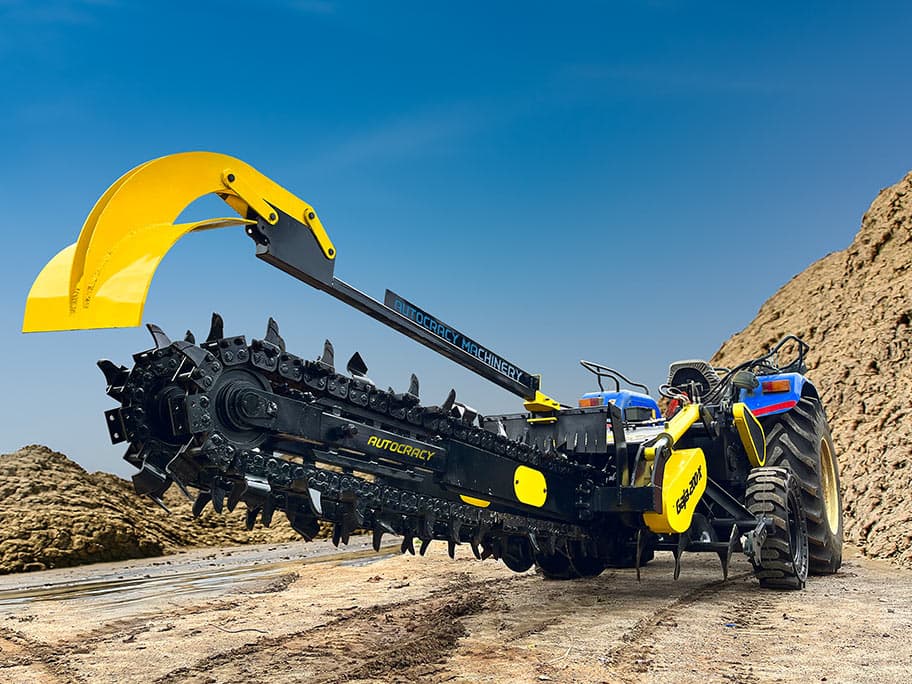
- | Attachment
Tractor
>75 HP
PTO / Hydraulic
150m/hr in soft soil, 100m/hr in hard soil
Up to 600mm
1200mm-1500mm
>25LPM
Large-scale construction programs require trenching systems capable of supporting high installation volumes while maintaining dimensional consistency and operational reliability. The Gaja 200XT construction network development trencher is suited for projects involving utility network expansion, industrial developments, transport infrastructure, and renewable energy facilities where deeper trench profiles are required.
Its heavy-duty trenching capability enables contractors to undertake underground works across varying soil conditions while maintaining construction sequencing and minimizing interference with parallel site activities. The machine is particularly applicable where multiple utility services must be installed within defined construction schedules. Its compatibility with standard tractor fleets also allows project teams to optimize equipment utilization, simplify logistics, and support continuous operations across geographically dispersed project locations.
PROJECT EXECUTION
Construction
Modern infrastructure projects increasingly require efficient installation of interconnected utility systems extending from primary networks to end-user service points. The Gaja 200XT construction route installation trencher supports the development of underground corridors for power distribution, fibre-optic communication, water conveyance, stormwater drainage, and renewable energy transmission infrastructure. It is suitable for utility extensions serving industrial facilities, commercial developments, residential zones, and remote infrastructure assets.
In last-mile connectivity projects, the machine enables controlled trench excavation along constrained alignments while reducing disruption to ongoing site operations. Consistent trench geometry also facilitates standardized installation procedures, supporting quality assurance requirements established by project owners, consultants, and regulatory authorities.
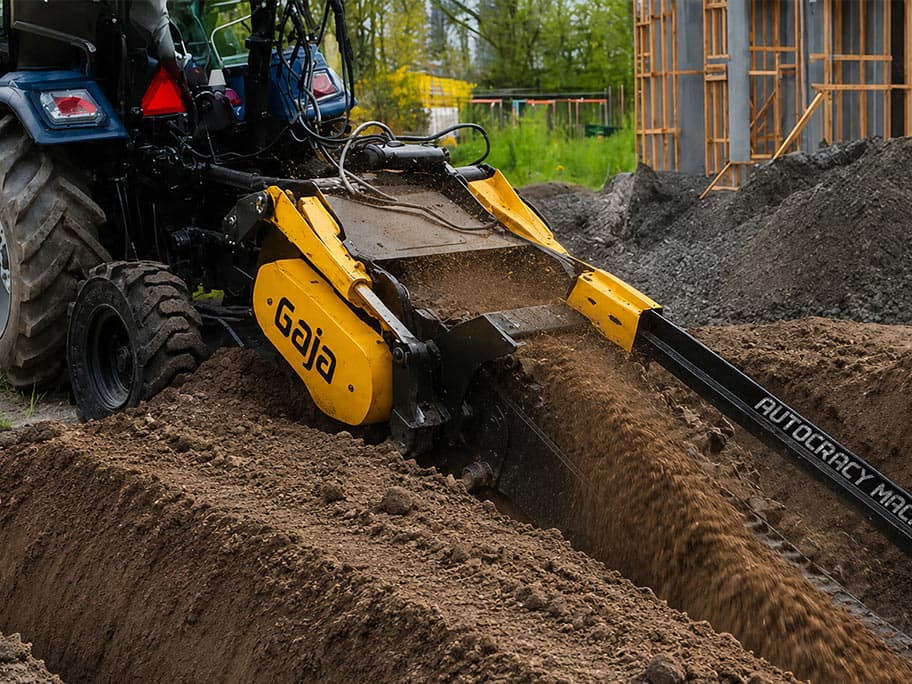
Construction
Effective trenching within construction environments depends on comprehensive pre-construction planning, accurate subsurface investigations, and coordinated execution strategies. Priority considerations include utility mapping, geotechnical assessment, right-of-way management, and alignment verification before excavation activities commence.
The Gaja 200XT civil utility construction equipment assists project teams undertaking complex underground utility installations requiring deeper excavation and consistent trench dimensions. Construction managers should establish clear spoil handling procedures, equipment movement plans, and interface management protocols to minimize operational conflicts across active worksites. Continuous monitoring of trench conditions, excavation progress, and installation tolerances further supports compliance with engineering specifications while reducing rework risks and maintaining overall project productivity.
WORKFLOW
Map route requirements, trench depth, and site access before deploying Gaja 200XT.
Use the attachment setup to keep trench output consistent across project sites, road edges, smart-city corridors, and underground utility zones.
Cleaner trench profiles help utility laying, inspection, backfill, and civil finishing teams proceed with less rework.
Autocracy Machinery can help match machine configuration, brochure details, and application guidance to the project.
APPLICATION SUPPORT
Share your site conditions, output goals, and timeline so the Autocracy team can guide model fit, brochure details, and next steps for your project.
Built for performance. Trusted by contractors, municipalities, and EPC teams across sectors.
| Feature | Value |
|---|---|
| Gross Weight | 3000 kgs |
| Overall Length | 5.1 mts |
| Overall Width | 2.621 mts |
| Overall Height | 1.3 mts |
Common questions about using Gaja 200XT in this application.
| Attachment

Industry model fit in India
For Construction deployment on India project sites, Gaja 200XT is considered when a attachment must handle active jobsites, compacted ground, access-controlled work fronts, and staged civil activity. The model should be reviewed against route cutting, trench preparation, and utility corridor work where line accuracy matters, site productivity, crew coordination, depth control, and fast mobilisation, and the way crews hand work over after each pass.
The first comparison for Gaja 200XT should be route clearance, equipment movement, working width, daily output, and safety coordination, because those factors usually decide field fit before horsepower, headline capacity, or attachment choice.
Gaja 200XT can support building services, drainage, foundations, road-edge utilities, and site preparation, depending on route condition, access, output target, operator workflow, and site support availability.
This model page is meant to support a more practical conversation about construction fit, brochure review, transport planning, deployment timing, and quote needs.
A better construction shortlist connects trench depth, trench width, spoil handling, route crossings, surface reinstatement, and carrier fit with active jobsites, compacted ground, access-controlled work fronts, and staged civil activity, so Gaja 200XT is reviewed against the actual job sequence.


