


Route Planning
Map route requirements, trench depth, and site access before deploying Pole Stacker 100XC.
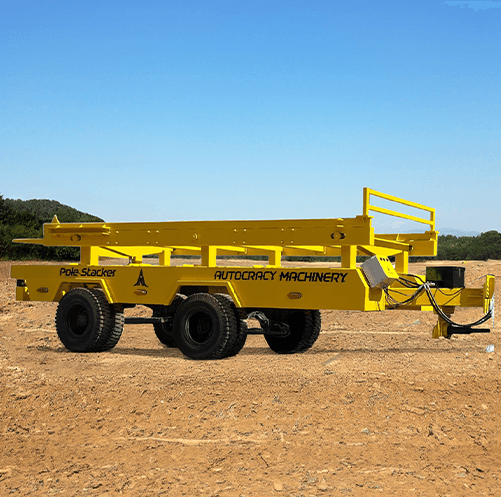
- | Equipment
Tractor
> 90
1.2 m
Chain Conveyor
10 MT
8 – 11 m
1600 – 2300 mm
In India’s rapidly expanding utility-scale solar sector, efficient handling and distribution of torque tubes and mounting structures is critical to maintaining installation speed, structural accuracy, and overall project timelines. Delays or inconsistencies in material movement can directly impact erection efficiency and increase dependency on manual labour. The Pole Stacker 100XC is designed to meet these requirements by delivering controlled, high-capacity handling combined with conveyor-assisted material transfer across large solar installations. As a tractor-mounted solution, it aligns well with Indian solar EPC execution models where tractors are widely available across project sites. This enables easy mobilization across vast solar fields, remote project locations, and semi-arid regions without dependency on cranes or heavy lifting machinery, making it highly practical for large solar parks across multiple regions in India. Maintaining uniform and continuous material flow is especially important in solar projects where torque tubes and mounting structures must be positioned accurately across long installation rows. The integrated automatic chain conveyor system ensures smooth and consistent transfer of structural members, reducing handling delays, minimizing manual effort, and improving placement efficiency. Its ability to operate across uneven terrain, loose soil, and rough site conditions allows uninterrupted material movement and distribution across large solar layouts, helping EPC contractors maintain steady execution and meet strict installation timelines.
PROJECT EXECUTION
Solar Energy
In India, solar power projects involve large-scale movement and placement of structural components used in module mounting systems. The Pole Stacker 100XC supports these requirements across key solar infrastructure applications.
It is widely used for transporting, conveying, lifting, and positioning torque tubes and mounting structures across solar installation sites. The machine enables smooth transfer of materials from storage areas to installation zones, along with conveyor-assisted loading, unloading, and stacking operations.
For large solar parks and ultra-mega renewable energy projects, maintaining consistent material flow and placement is critical. The machine ensures uniform transfer, reduces manual handling, and supports both intra-site logistics and installation support activities.
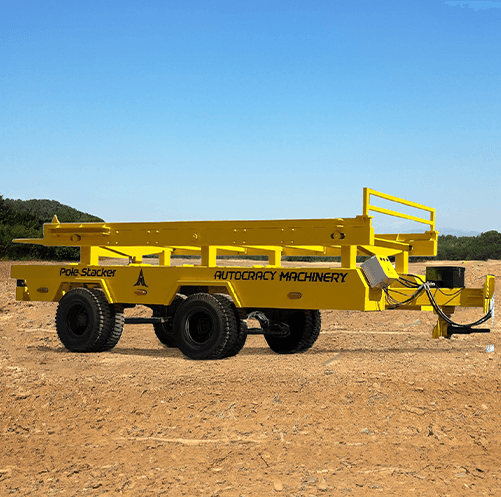
Solar Energy
In Indian solar EPC projects, execution priorities revolve around speed, safety, and operational efficiency. The Pole Stacker 100XC is designed to address these requirements effectively. Efficient and continuous material transfer is essential to avoid installation delays. Manual handling or non-uniform movement of torque tubes can slow down erection workflows and increase labour dependency. The integrated chain conveyor system enables smooth and uniform transfer, significantly improving installation speed.
Safe handling of long and heavy structural members is critical to prevent damage and ensure proper alignment. The machine provides controlled lifting and stable transportation, while the hydraulic remote-control system allows operators to position materials safely from a distance, reducing on-site risks.
Time-bound solar installations require fast deployment and flexibility. Since the machine works with commonly available tractors above 90 HP, it reduces setup time and eliminates the need for multiple pieces of material handling equipment. By reducing manual labour, enabling conveyor-assisted operations, and improving overall handling efficiency, the Pole Stacker 100XC supports faster project execution while maintaining the quality standards required for India’s growing renewable energy infrastructure.
WORKFLOW
Map route requirements, trench depth, and site access before deploying Pole Stacker 100XC.
Use the attachment setup to keep trench output consistent across solar park rows, inverter blocks, and power evacuation corridors.
Cleaner trench profiles help cable laying, earthing, backfilling, and commissioning teams proceed with less rework.
Autocracy Machinery can help match machine configuration, brochure details, and application guidance to the project.
APPLICATION SUPPORT
Share your site conditions, output goals, and timeline so the Autocracy team can guide model fit, brochure details, and next steps for your project.
Built for performance. Trusted by contractors, municipalities, and EPC teams across sectors.
| Feature | Value |
|---|---|
| Overall Length | 7.5 m |
| Overall Width | 2.2 m |
| Overall Height | 1.8 – 2.25 m |
| Overall Weight | 4500 kgs |
Common questions about using Pole Stacker 100XC in this application.
Industry model fit in India
Pole Stacker 100XC is presented for Solar Energy applications on India project sites, where a equipment has to work around solar parks, cable corridors, pile rows, open sites, and long internal utility runs. This page adds india-focused context for pole stacker, so teams can judge whether the model supports repeatable output, cable-route accuracy, panel-field access, and EPC schedule control.
Start by checking Pole Stacker 100XC against array layout, cable depth, tracker clearance, soil profile, and commissioning milestones; that route-specific review is more useful than treating every pole stacker page as the same model brochure.
Common solar energy use cases for Pole Stacker 100XC include DC cable trenches, earthing routes, tracker support works, inverter corridors, and solar EPC utilities, provided the site setup supports the machine, crew movement, and next work stage properly.
Use this model page to discuss Solar Energy fit, specification limits, transport readiness, brochure details, and quote requirements with Autocracy Machinery.
project teams in India should confirm repeatability, row access, site spread, utility sequence, and EPC schedule pressure before shortlisting Pole Stacker 100XC, especially when solar parks, cable corridors, pile rows, open sites, and long internal utility runs affect access or productivity.

