Anyone who has worked around a lake, river or canal knows that reaching the work area is not always easy. The machine may be parked just a few meters from the water, yet getting it to the actual location can be a completely different matter.
The ground near the bank is often soft. In some places it is covered with mud, while in others the water is too deep for a normal excavator to enter. During the monsoon, these conditions become even more difficult. Building a temporary access road or working platform is possible, but it adds another activity to the project before the actual maintenance work can begin.
This is where an amphibious excavator makes sense.
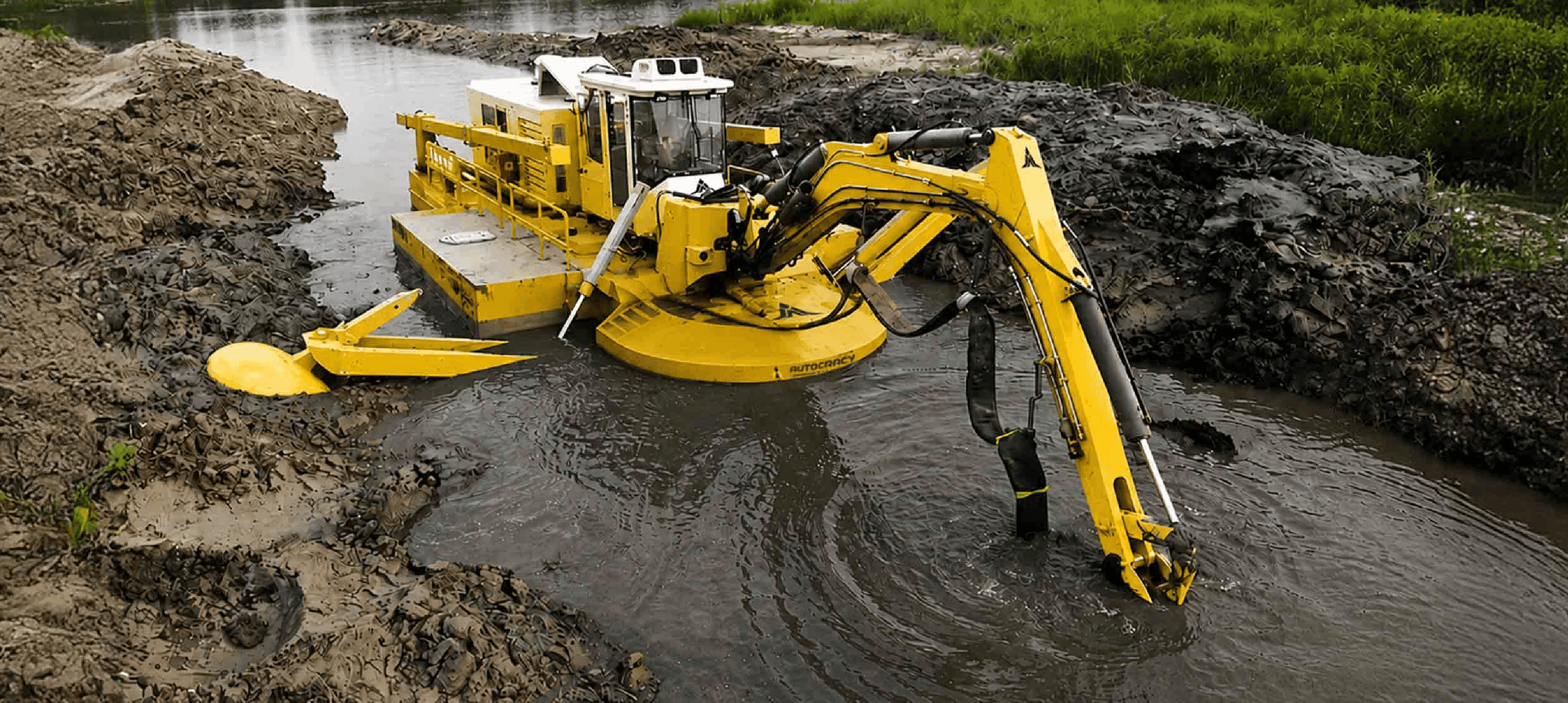
Instead of depending on a firm surface, it works on a pontoon-based undercarriage. The pontoons provide flotation and spread the machine's weight, allowing the excavator to operate in shallow water, marshy areas, and soft ground.
For waterbody maintenance, that simple difference can determine whether a particular section is accessible or not.
Take lake desilting as an example. Over the years, soil and other material enter the lake through runoff and drainage channels and settle at the bottom. Eventually, some portions become considerably shallower than they were originally.
The need for desilting may be obvious, but the machine still has to reach the sediment.
Working entirely from the shore limits how far a conventional excavator can reach. Bringing the excavator further into the lake is not always possible because the lakebed may not support its weight.
The same situation occurs in rivers and canals. Sediment collects in certain sections, vegetation grows along the edges, and debris gets trapped in the channel. The areas that need attention are often the areas where access is most difficult.
A floating excavator is designed for precisely these conditions. Its pontoons allow the excavator to move over soft surfaces and shallow water instead of requiring a conventional firm working platform.
The machine itself performs many of the same basic excavation tasks as a conventional excavator. The difference is where it can perform them.
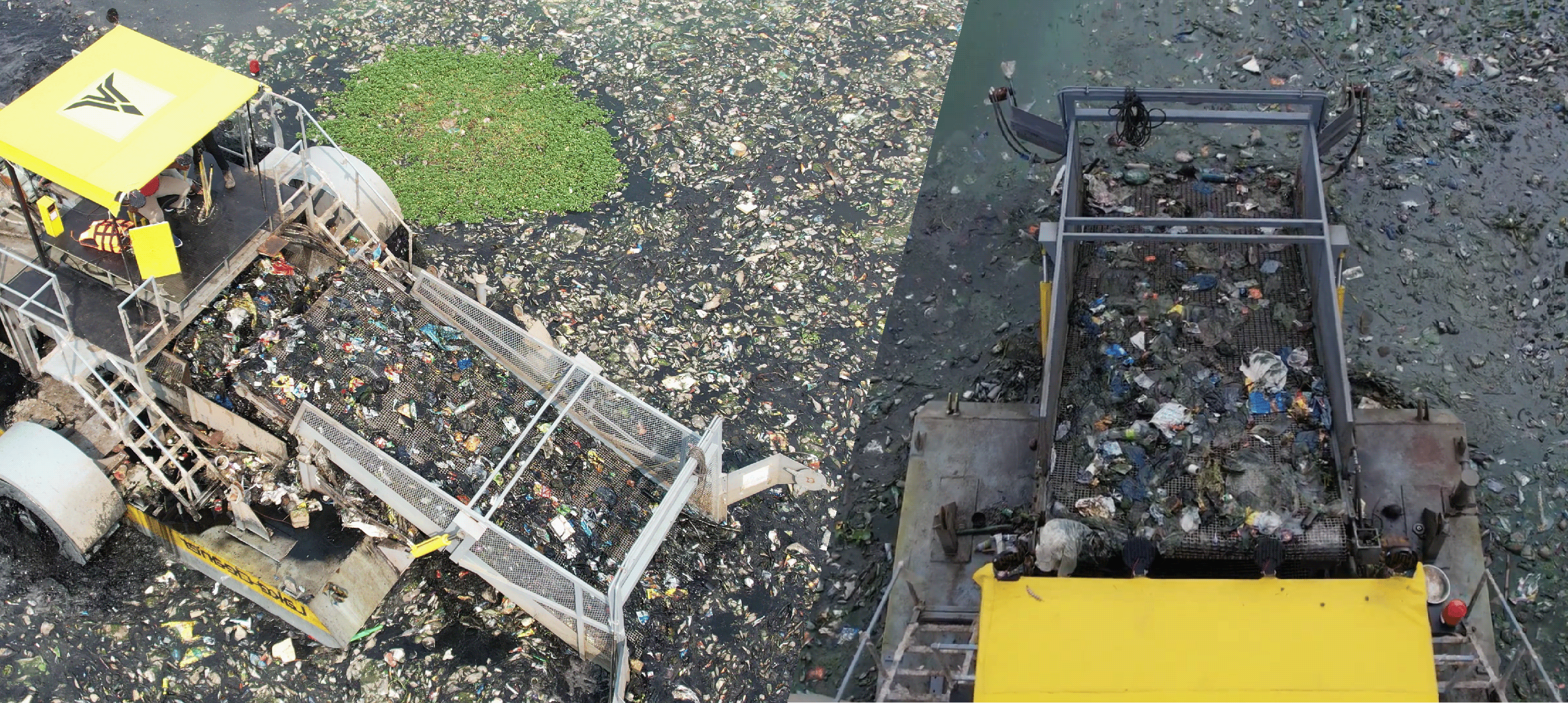
For desilting work, a bucket can be used to remove accumulated sediment. Where aquatic plants are the main problem, a weed bucket can be fitted. Rakes can be used to gather vegetation and loose material, while grabs or clamshells can be useful for handling debris.
This flexibility is useful on projects where conditions change from one part of the site to another.
A lake, for instance, may have silt in one area and dense vegetation in another. A river project may involve clearing a channel as well as removing material from its banks. There is no need for every task to be treated as a completely separate operation when the excavator can be configured with the appropriate attachment.
Desilting is one of the most common applications.
When sediment continues to accumulate, the available depth of a lake or pond gradually decreases. The problem may go unnoticed for years because the change happens slowly.
Once a decision is made to remove the sediment, access becomes a major consideration.
An amphibious excavator can work from shallow sections and soft edges of the waterbody, allowing excavation to take place closer to where the sediment has accumulated.
Of course, excavation is only one part of a desilting project. The removed material has to be lifted, transported, and taken to an appropriate location. The project team also has to consider access for trucks or other equipment handling the material. Good planning is therefore just as important as the excavator itself.
Rivers are constantly changing. Sediment moves with the current and settles where the flow slows down. Vegetation can establish itself along the banks, while branches, waste and other debris can collect in the channel.
In these situations, a river excavation machine can provide access to sections that are difficult to approach with equipment working entirely from the bank.
Canal maintenance presents a similar challenge. A canal may have sufficient water depth for part of its length and soft, narrow banks along another section. A conventional excavator may have nowhere suitable to stand.
An amphibious machine gives the operator another option. Instead of bringing the machine to the canal, the machine can work from within the water or on the soft terrain alongside it, depending on the site conditions.
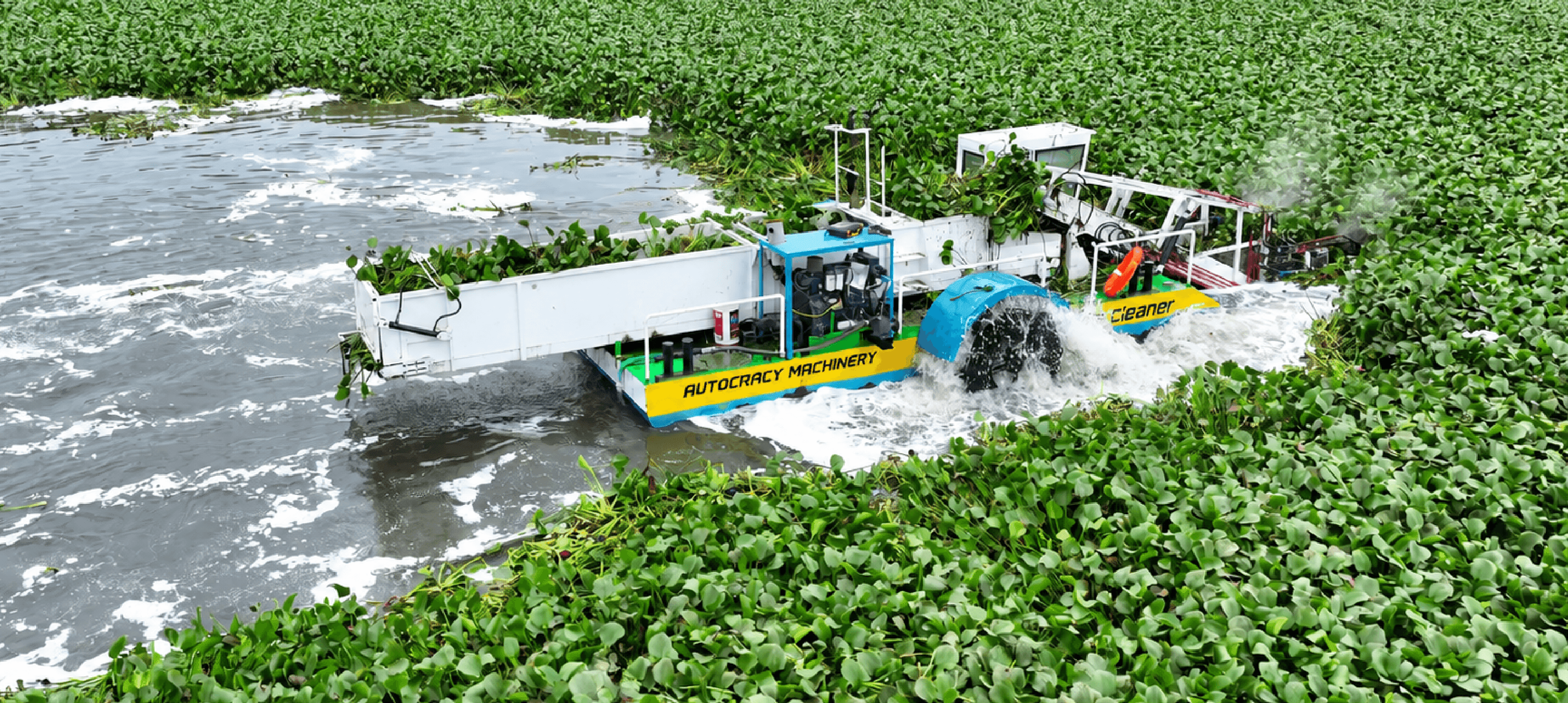
Water hyacinth and other aquatic weeds can quickly become a serious maintenance issue. What starts as a small patch can eventually cover a large section of a lake or pond.
Removing a few plants manually is one thing. Removing tons of vegetation spread across a large waterbody is another.
This is where mechanical removal becomes useful. An amphibious excavator fitted with a suitable weed-handling attachment can move into affected areas, collect the vegetation, and bring it towards the bank or another designated collection point.
The removed vegetation still needs to be handled after it reaches the shore. But the machine takes care of one of the most difficult parts of the job: reaching the vegetation in the first place.
Some sites have very little actual open water but are still difficult for ordinary machinery.
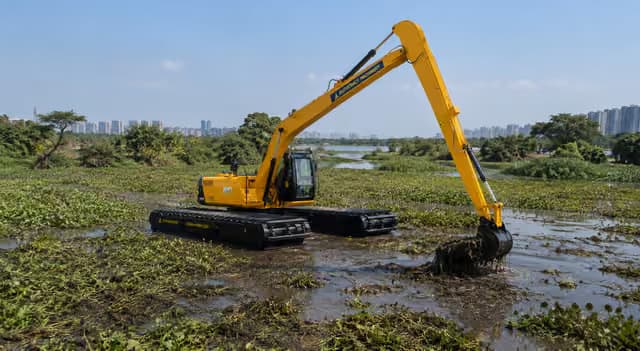
Wetlands, marshes and waterlogged areas can have extremely poor ground conditions. A conventional excavator can sink into the surface or become difficult to manoeuvre.
The pontoons distribute the machine's weight over a larger area. This allows it to work across terrain where a conventional tracked excavator may not be practical.
This does not mean every wetland or marsh can automatically support an amphibious excavator. Ground conditions, water depth, excavator weight, and the proposed operation need to be checked before the machine is deployed.
The size of the excavator matters when selecting an amphibious platform.
The Rudra Amphimax 100EP is designed for 6-10 tonne excavators. It is intended for work in shallow water and unstable terrain where access from firm ground is restricted.
For larger excavation requirements, the Rudra Amphimax 250EX is designed for 21-25 tonne excavators. The larger configuration is suited to projects where a heavier excavator is required for excavation and material-handling work.
The choice between the two is not simply about selecting a larger or smaller machine. The excavator operating weight, reach, attachment, water depth, and ground conditions all have to be considered together.
For contractors, one of the biggest considerations is how much preparation is required before the excavator can start working.
If a site requires extensive temporary access just to get a conventional excavator into position, the project becomes more involved. There are additional activities to plan, additional equipment to arrange, and additional time before excavation can begin.
An amphibious platform can remove some of that difficulty where site conditions are suitable.
It also gives the contractor more flexibility when the working conditions change. The machine can move between soft ground and shallow water, allowing work to continue in areas where ordinary equipment may have to stop.
The other practical benefit is the range of attachments. One machine can handle different types of work instead of being limited to a single excavation task.
Waterbody maintenance is easy to postpone because many of the problems develop gradually.
A little more silt settles each year. Vegetation occupies another section of the water surface. A canal becomes narrower as material accumulates. A riverbank becomes softer and more difficult to approach.
Eventually, these changes affect the way the waterbody functions and the amount of maintenance required.
The difficulty is that by the time the problem becomes urgent, access may have become more complicated as well. A job that could have been handled as routine maintenance may now require more equipment, more preparation, and more time.
Regular inspection and planned maintenance can help identify these changes before they become much larger problems.
There is no universal amphibious configuration for every waterbody.
Before selecting the equipment, the project team needs to look at the actual site. How deep is the water? What is the condition of the soil? How heavy is the excavator? What is the required reach? Is the material mainly silt, vegetation, or debris? Which attachment will be used?
These questions have a direct bearing on the equipment required.
The way excavated material will be removed from the site also needs to be considered. A machine may reach the sediment without difficulty, but the overall operation will still depend on how efficiently the material can be handled afterwards.
There is nothing particularly complicated about the reason for using an amphibious excavator. When the work is in a place where a normal excavator cannot comfortably stand, another approach is needed.
Pontoons provide that approach. They allow an excavator to work in shallow water and soft terrain while using attachments suited to the material being handled.
Autocracy Machinery's Rudra Amphimax range includes the 50EX, 100EX, 250EX, and 100EP, with configurations suited to different excavator sizes and working conditions. The range supports waterbody maintenance activities such as desilting, vegetation removal, and excavation where conventional access is difficult.
FAQs
It is used for excavation, desilting, weed removal, debris handling, and maintenance work across shallow water, wetlands, marshes, and soft terrain.
Large pontoons provide flotation and distribute machine weight, allowing the excavator to operate across shallow water and unstable ground conditions.
They can be used in lakes, rivers, canals, wetlands, ponds, marshes, reservoirs, and other areas with difficult ground access.
Yes, suitable attachments allow the machine to remove accumulated silt from shallow lake sections where conventional excavators cannot safely operate.
Common attachments include buckets, weed buckets, rakes, grabs, and clamshells, depending on the material being excavated, collected, or handled.
The Rudra Amphimax range includes 50EX, 100EX, 250EX, and 100EP configurations, designed for different excavator sizes and applications.
Pontoons distribute the excavator's weight across a wider surface, improving flotation and allowing operation on soft, muddy, waterlogged, and shallow areas.
Yes, they can operate around soft riverbanks and canals, providing access where conventional excavators may require additional ground preparation or platforms.
Consider excavator weight, water depth, ground conditions, required reach, excavation requirements, attachment type, transportation, and material-handling arrangements before selection.
10. Can it remove heavy mud from shallow water areas?
Yes, suitable attachments can loosen, collect, and remove accumulated mud from shallow water sections without requiring conventional equipment to enter the waterbody.