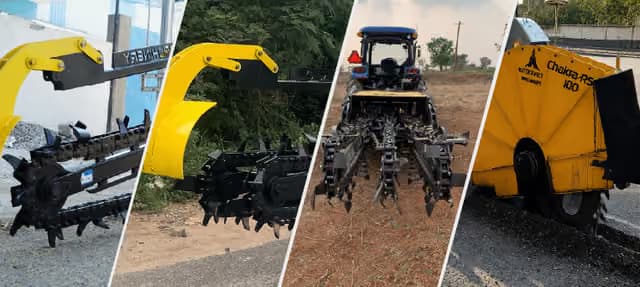
Optical fiber cable (OFC) networks are essential for expanding broadband access and telecommunications infrastructure throughout India. As fiber rollout projects expand into rural areas, urban developments, and last-mile connectivity networks, contractors need efficient ways to build underground ducts while coordinating excavation, duct placement, and backfilling.
To handle these jobs individually, many equipment operations, additional coordination, and careful worksite planning may be required. For contractors overseeing long-distance fiber routes, an integrated duct-laying solution can simplify the installation procedure.
Autocracy Machinery's Mayura TO is designed to use a single tractor with more than 60 horsepower to accomplish trenching, HDPE duct laying, and backfilling all at once. It is a viable option for OFC deployment and related subterranean utility projects due to its integrated architecture.
Comprehending OFC Duct-Laying Requirements
The preparation of an underground tunnel, the installation of HDPE ducts, and the backfilling of the dug trench are all necessary for the installation of OFC. The required trench size and duct parameters are determined by the project design, ground conditions, and installation requirements.
When each task is finished individually, contractors must coordinate equipment and work phases to maintain progress throughout the route. Planning equipment may become more difficult as a result, especially when working across large fiber rollout networks.
A dedicated OFC duct-laying machine combines these activities into a coordinated operation. The Mayura TO brings trench excavation, duct deployment, and trench closure together, reducing the need for separate machine passes for each stage.
How the Mayura TO Supports OFC Installation
The Mayura TO integrates three essential functions for underground HDPE duct installation.
1. Precision Trenching
Its chain trencher excavates trenches between 110 mm and 280 mm wide, with depths of up to 1800 mm. This operating range allows contractors to assess the machine against the trench dimensions specified for their OFC projects.
2. Integrated HDPE Duct Laying
As the equipment moves forward, an HDPE duct is deployed into the trench by a front-mounted hydraulic decoiler. It can accommodate duct rolls up to 2000 mm in outside diameter and 600 mm in breadth, with duct sizes ranging from 30 to 60 mm.
The equipment helps remove the need to set up a separate duct-laying pass for suitable installations by coordinating duct placement with trench excavation.
3. Backfilling in the Same Pass
The trench behind the duct-laying operation is backfilled by an integrated two-plate dozer. Depending on the configuration and project specifications, its filling width can be set between 1000 and 2500 mm.
When combined, these features allow the Mayura TO to finish backfilling, trenching, and duct deployment in a single coordinated pass, which helps contractors streamline the order of OFC installation tasks.
Why Is the Mayura TO a Good Option for OFC Contractors?
The Mayura TO combines several functions into a single machine configuration to meet the practical needs of installing subterranean ducts.
One-pass operation: Combines backfilling, HDPE duct installation, and trenching.
Single-tractor setup: Operates with a tractor above 60 HP, bringing the three functions together in one operating arrangement.
Defined trench dimensions: Supports trench widths of 110-280 mm and depths of up to 1800 mm.
Hydraulic decoiler: Accommodates HDPE duct rolls up to 2000 mm in outside diameter.
Integrated backfilling: Closes the trench behind the duct-laying operation.
Operating performance: Offers a stated trenching speed of up to 300 m/hr, with approximately 150 m/hr in soft soil and 90 m/hr in hard soil.
By combining these operations, the Mayura TO can help reduce separate equipment movements and simplify worksite coordination. Actual productivity depends on soil conditions, trench dimensions, route alignment, duct-roll changes, and other site requirements.
Applications in Fiber Optic and Telecom Infrastructure
Fiber Broadband Rollout: When the machine's capabilities and the required trench dimensions align, it makes it easier to lay HDPE ducts for underground fiber networks.
Last-Mile Connectivity: Appropriate rural and urban routes connecting structures, neighborhoods, and other network access points may be taken into account.
Telecommunication Infrastructure: Enables the construction of appropriate underground ducts for communication networks and related utility installations.
The Mayura TO can be evaluated for pipeline, drainage, and irrigation projects that require coordinated trenching and backfilling, in addition to telecommunications.
Key Specifications of the Mayura TO
Specification Details
Support vehicle Tractor
Tractor requirement Above 60 HP
Transmission PTO / Hydraulic
Maximum trench depth 1800 mm
Trench width 110-280 mm
Duct diameter 30-60 mm
Maximum duct-roll outside diameter 2000 mm
Duct-roll width 600 mm
Backfilling width 1000-2500 mm
Trenching speed Up to 300 m/hr
Speed in soft soil Approximately 150 m/hr
Speed in hard soil Approximately 90 m/hr
Fuel consumption 5-6 L/hr
These specifications help contractors evaluate whether the machine matches their trench profile, duct requirements, available tractor, and site conditions.
Planning an OFC Project with the Mayura TO
Contractors should verify the necessary trench size, duct diameter, roll arrangement, and backfilling requirements prior to choosing equipment for an OFC project. Additionally, the machine's PTO/hydraulic needs and tractor compatibility should be evaluated.
Another crucial factor is route accessibility. The dimensions of the Mayura TO are 10,500 mm for length, 3200 mm for breadth, and 4500 mm for height. Road widths, turning areas, entry points, and available workspace should all be compared to these measurements.
When assessing trenching productivity, contractors should also take ground conditions into account. Realistic operation schedules can be established by making plans for route preparation, machine repositioning, and duct-roll replacement.
Matching these requirements with the Mayura TO's capabilities allows project teams to determine whether its integrated one-pass configuration is suitable for their OFC deployment needs.
Conclusion
As fiber connectivity expands, efficient underground duct installation remains an important part of OFC infrastructure development. Coordinating trenching, HDPE duct placement, and backfilling can help contractors organize installation activities and reduce the need for separate equipment passes.
The Mayura TO by Autocracy Machinery brings these three operations together in one pass using a single tractor above 60 HP. It offers a coordinated solution for compatible OFC duct-laying projects with trenching depths of up to 1800 mm, widths of 110-280 mm, a front-mounted hydraulic decoiler, and an integrated two-plate backfilling dozer.
When planning underground fiber installations, telecom contractors, fiber network developers, and infrastructure businesses should take the Mayura TO into account. Contractors can choose an equipment configuration that best suits their installation needs by comparing its capabilities with project specifications, duct requirements, and site conditions.
For your OFC duct-laying and subterranean telecom infrastructure needs, consider Autocracy Machinery's Mayura TO.