


Digging a trench is only one part of underground infrastructure work. Once cables, pipelines, or other utilities are placed, the trench still needs to be restored properly. This stage may not receive the same attention as excavation or installation, but it directly affects the project's quality, safety, and progress.
Backfilling often involves moving large quantities of sand, soil, gravel, or crusher dust into long stretches of open trench. When this is done manually or with equipment that is not designed for continuous material placement, the work can become slow and labour-intensive. Material may not reach the required locations evenly, and additional handling can increase both time and operating costs.
This is where a sand filler machine can make a practical difference.
Underground cables and pipelines need more than simply being covered with excavated soil. The material surrounding them can provide protection against external pressure, movement, and damage during the later stages of construction.
For many utility projects, screened sand is placed around the installed infrastructure before the remaining trench is filled. This creates a protective layer between the utility and the surrounding soil or larger particles.
The challenge is handling this material efficiently.
Large projects may involve kilometres of trench, which means thousands of tonnes of material can have to be moved and placed. If workers are required to spread the material manually or repeatedly reposition equipment, productivity can quickly fall behind the excavation and installation teams.
A dedicated material-placement system helps keep these activities moving together.
One of the biggest advantages of purpose-built equipment is that material does not simply have to be dropped beside the trench.
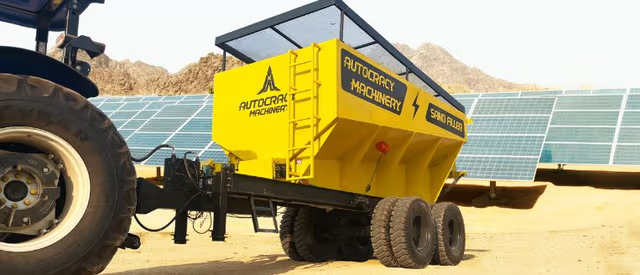
A large hopper allows bulk material to be loaded and held before placement. From there, a hydraulic conveyor can carry the material toward the required discharge point. This creates a continuous flow instead of relying on repeated loading and manual spreading.
The difference becomes particularly noticeable on long utility corridors.
Rather than bringing material to the trench in small quantities, the machine can handle a larger volume and deliver it where it is needed. The conveyor also provides greater control when working around existing infrastructure or in areas where access for larger equipment is restricted.
For contractors, this can mean fewer interruptions and less dependence on manual labour.
Solar projects are a good example of where efficient trench restoration matters.
Large solar farms often require extensive underground cable networks connecting equipment across the site. These trenches may extend over considerable distances, and the work has to be coordinated with cable installation, testing, road construction, and other site activities.
Once the cables are installed, padding and backfilling cannot become a bottleneck.
A sand padding equipment solution can help maintain the pace by moving and placing screened material continuously along the trench. The operator can control the material flow while the conveyor reaches areas that may be difficult to access directly with a vehicle.
This is particularly useful when several work fronts are active at the same time. Faster restoration allows other teams to move into completed sections instead of waiting for manual backfilling to catch up.
Trench restoration requirements can vary from one project to another. Some sites may require screened sand, while others may use gravel, soil, or crusher dust depending on the application and engineering requirements.
The ability to handle different materials gives the equipment greater practical value across infrastructure work.
Screening also plays an important role. Material with oversized particles may not be suitable for areas immediately surrounding sensitive underground utilities. A controlled screening system can help maintain a more consistent material size before it reaches the trench.
With screening capability up to 25 mm, the machine can support projects where controlled material grading is important.
This is not simply about moving more material. It is about placing the appropriate material in a more controlled manner.
Backfilling can require a considerable amount of manual work when conventional methods are used. Workers may need to guide material, spread it along the trench, move excess material, and correct areas where distribution is uneven.
Over long distances, these tasks become physically demanding and time-consuming.
Automation of material movement does not eliminate the need for skilled workers. Instead, it allows the available workforce to focus on machine operation, site coordination, quality checks, and other activities that require attention.
A backfilling machine can therefore become part of a wider workflow rather than functioning as an isolated piece of equipment.
The excavator opens the trench. Installation teams place the cable or pipeline. Padding material is then delivered and distributed. Once the protective layer is completed, the remaining backfill can proceed.
When these stages work together, the entire site operation becomes easier to coordinate.
Not every trench is located in an open construction area.
Urban utility projects, industrial facilities, solar installations, road corridors, and other infrastructure sites can have restricted access. Buildings, existing utilities, temporary roads, and other site conditions may limit where conventional equipment can operate.
A long-reach conveyor provides an advantage in such situations by allowing material to be discharged away from the main machine position.
Wireless remote control can further improve operator convenience, particularly when the machine needs to be monitored from a suitable position around the working area.
These features may appear simple individually, but together they can make a noticeable difference when the work has to continue in difficult site conditions.
The value of efficient backfilling goes beyond the machine itself.
When trenches are restored faster, access routes can reopen sooner. Other construction teams can enter completed sections without waiting for unfinished backfilling work. Material handling becomes easier to plan, and the number of separate machines and manual operations required at the site can be reduced.
This becomes increasingly important on large infrastructure projects where several activities are running simultaneously.
For project managers and contractors, productivity is not always about increasing the speed of one machine. It is about preventing one stage from slowing down everything that follows.
Efficient material placement helps remove one of those potential bottlenecks.
Underground infrastructure remains out of sight once a project is complete, but the quality of its installation continues to matter long after construction crews leave the site.
Proper padding and backfilling help protect buried utilities and provide a more stable finished trench. Consistent material placement can also reduce the possibility of voids, uneven settlement, and unnecessary rework.
For contractors handling utility corridors, solar farms, pipelines, and other large-scale infrastructure projects, investing in the right material-handling approach can therefore have a practical impact on both productivity and finish quality.
The Sand Filler is designed around this requirement. With its high-capacity hopper, hydraulic conveyor, vibration-assisted material flow, screening capability, and wireless control, it brings several stages of material handling into one coordinated operation.
Autocracy Machinery develops practical machinery around the real challenges faced on infrastructure sites, with a focus on making demanding field operations more efficient and manageable. Its approach combines engineering, manufacturing, and application-focused design to support contractors through the different stages of project execution.
The result is a simpler approach to a task that is often treated as routine.
Because in underground construction, the job is not finished when the trench is dug or the cable is laid. It is finished when the trench is restored properly, efficiently, and ready for the next stage of the project.


