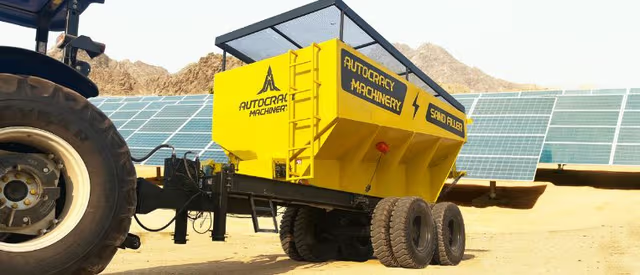
Trenching requirements can change considerably from one project to another. An OFC route may require a narrow and consistent trench, while a pipeline, irrigation, solar, drainage, or utility project may demand greater width and depth.
This makes trencher machine selection more than a matter of choosing the largest available equipment. The required trench profile, soil conditions, route length, carrier, access conditions, and application all influence which machine is appropriate.
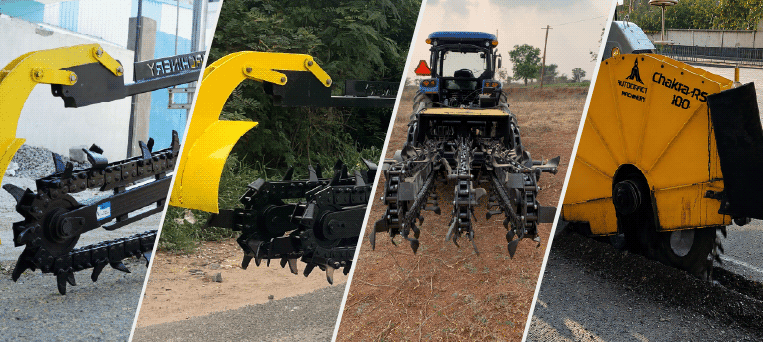
Autocracy Machinery offers a range of trencher equipment designed around different trenching requirements, including chain trenchers, tractor-mounted solutions, equipment-based trenchers, and wheel trenchers.
A trencher is designed specifically for continuous excavation along a defined route. Unlike general excavation equipment, its operation is centered around producing a controlled trench profile as the machine progresses.
This makes trenchers suitable for applications such as OFC telecommunications, pipelines, irrigation, solar energy, drainage, utilities, construction, agriculture, defence, and water management.
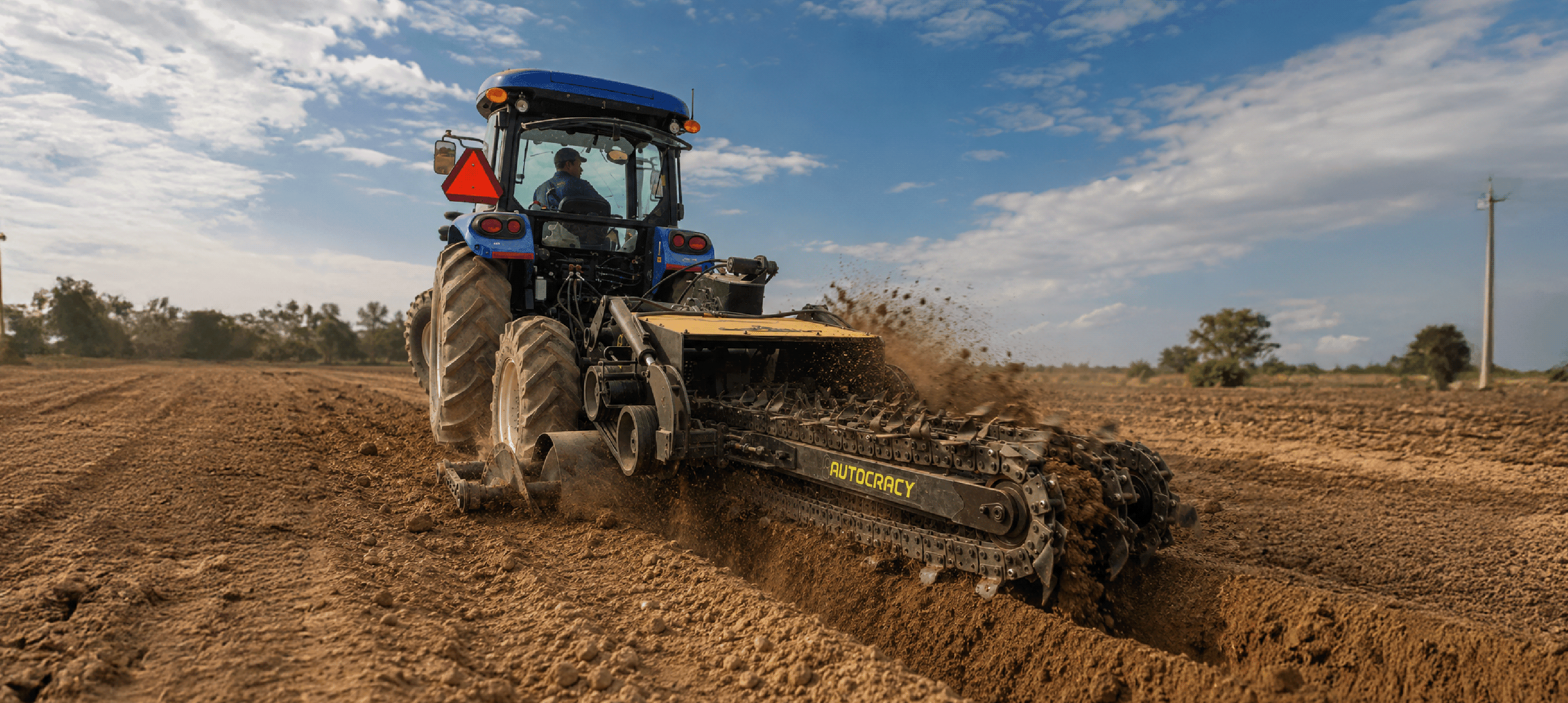
A chain trencher is particularly suited to projects where continuous linear trenching is the primary requirement. The cutting system excavates the ground while the machine advances along the planned route.
The key consideration is matching the machine's trenching capability with the actual project requirement rather than using the same configuration across different applications.
Trench width and depth are among the first factors to consider when selecting a trench digging machine.
For narrower utility and OFC requirements, models such as the Gaja 100XT offer trench widths of 110-280 mm and depths of 1200-1500 mm. The Gaja 200XT extends the available trench width up to 600 mm while maintaining a 1200–1500 mm depth range.
For wider trenching requirements, the Gaja 300XC supports widths up to 900 mm, while the Gaja 400XC supports widths up to 1200 mm, with both models offering trench depths of 1200-1500 mm.
This range allows contractors to consider equipment according to the required trench profile instead of adapting the project around a single machine.
A tractor-mounted trencher can be considered when a compatible tractor is already available for the project.
Autocracy Machinery's tractor-based trencher options are designed for infrastructure applications where carrier compatibility, trench dimensions, site access, and productivity requirements need to be considered together. The company's product range includes tractor-mounted Gaja models with different trenching capacities.
For contractors working across OFC, irrigation, agriculture, solar, utilities, and other infrastructure applications, selecting the right tractor and trencher combination can help align the equipment with the site's operating requirements.
Not every trenching project has the same operating requirement. The Mayura Series provides additional configurations for projects requiring different trench widths, depths, and equipment capabilities.
The Mayura TL and Mayura TW support trench widths from 110-900 mm and depths up to 1800 mm. The Mayura TO supports narrower trenching from 110-280 mm and depths up to 1800 mm.
These configurations can be considered for projects where deeper trenching or different operating requirements need to be accommodated within the machine selection.
Chain trenchers are not the only option for trenching applications. A wheel trencher can be useful where the project requires a different cutting approach and a narrower trench profile.
Autocracy Machinery's Chakra RS100 Wheel Trencher supports trench widths of 50 mm, 65 mm, and 80 mm, with trench depths up to 450 mm.
This type of configuration can be considered for applications where a narrow and relatively shallow trench is required.
The right trencher equipment should be selected after considering the complete project requirement.
Key factors include:
Required trench width and depth
Soil type and ground conditions
Route length and alignment
Required excavation output
Tractor or carrier availability
Site access and working space
Existing underground utilities
Spoil handling requirements
Industry and application
These factors help determine whether a particular trencher machine configuration is suitable for the project.
Autocracy Machinery's trencher range provides multiple configurations for different infrastructure and excavation requirements.
From narrower OFC and utility trenches to wider infrastructure applications, the range includes Gaja, Mayura, Rudra, and Chakra models with different trenching capacities. The official range includes trench depths from 450 mm to 1800 mm and trench widths from 50 mm to 1200 mm, depending on the model.
The selection process should therefore begin with the project rather than the machine name. Define the required trench dimensions, understand the ground conditions, identify the available carrier, and then compare the machine configurations that meet those requirements.
A trencher is not simply a machine for digging a line in the ground. Different projects demand different trench widths, depths, cutting methods, carrier configurations, and operating capabilities.
Choosing the right machine means matching these requirements with the appropriate equipment configuration.
Whether the project involves OFC, pipelines, irrigation, solar, utilities, construction, agriculture, or other infrastructure applications, the right machine can help maintain a controlled trench profile and support a more organized excavation process.
With multiple configurations across its trencher range, Autocracy Machinery provides options for contractors to evaluate according to their specific project requirements.
Designed for continuous route-based trenching.
Creates consistent trenches along defined routes.
Supports controlled underground infrastructure excavation.
A trencher operated with a compatible tractor.
Match trench dimensions with project requirements.