Excavation becomes significantly more complicated when the worksite moves beyond firm, accessible ground. Wetlands, marshes, shallow waterways, riverbanks, reservoirs, and waterlogged areas can restrict machine access, reduce ground stability, limit excavation reach, and make continuous operation difficult.
For contractors, the problem is not simply finding a machine that can dig. The bigger challenge is finding equipment that can reach the work area, remain stable while operating, excavate from a suitable position, and adapt to changing tasks without extensive site preparation.
This is where the Rudra Amphimax 250EX amphibious excavator provides a purpose-built solution.
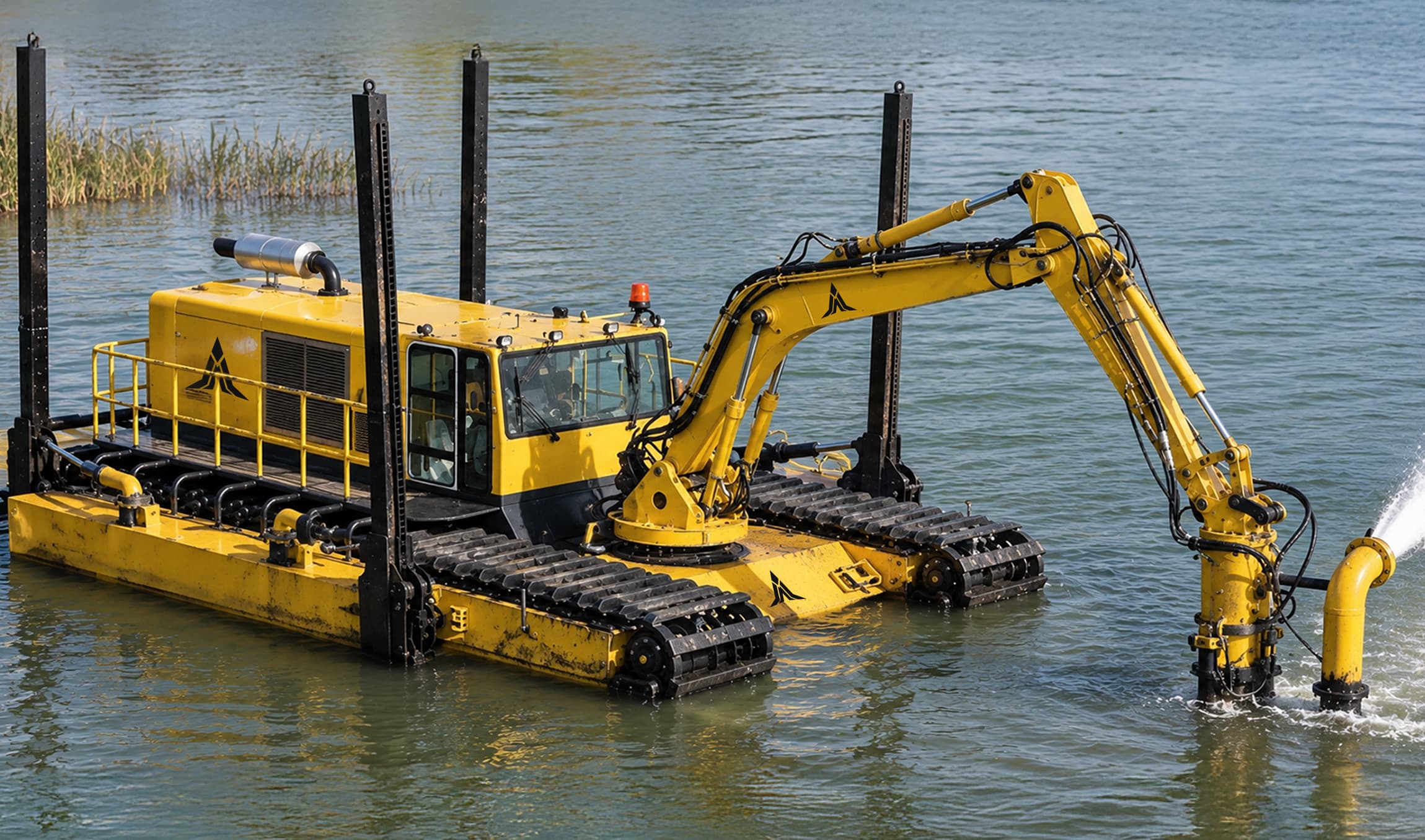
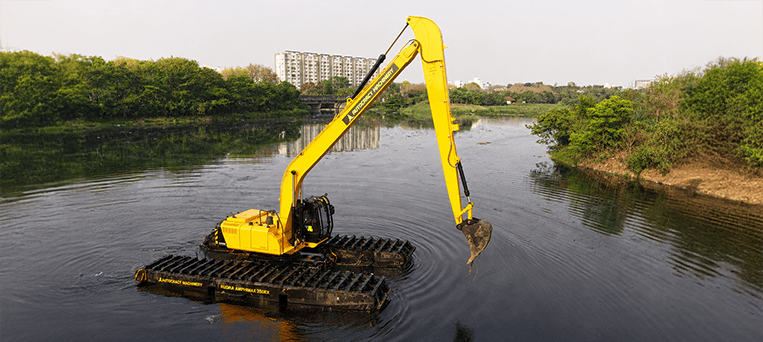
Conventional excavators can face mobility and positioning limitations when projects extend into soft, waterlogged, or aquatic environments. The Rudra Amphimax 250EX pontoon excavator addresses these challenges with a 21-25 ton amphibious configuration featuring marine-grade steel pontoons, wide amphibious tracks, hydraulic extendable floating stability, and long-reach excavation capabilities. Its self-propelled amphibious mobility allows it to move through suitable work areas as excavation progresses, supporting applications such as wetland restoration, canal maintenance, flood management, shoreline work, dredging, and aquatic vegetation removal.
Getting to the excavation area is often the first challenge.
The Rudra Amphimax 250EX river excavation machine uses high-flotation pontoons and wide amphibious tracks to distribute machine load across suitable soft terrain. Its hydraulic, extendable pontoon system provides additional floating stability when operating in water.
The pontoons are constructed from marine-grade steel, creating a purpose-built platform for demanding aquatic environments.
This combination of flotation, mobility, and stability helps reduce dependence on conventional ground access preparation where site conditions allow amphibious operation.
Reaching the work area is only useful if the machine can excavate efficiently once it gets there.
The Rudra Amphimax 250EX is equipped with an 8.5-9.0 m boom and a 9.4 m arm, providing a maximum digging depth of 9.4 m. This long-reach configuration allows operators to access a wider working area from the machine's position, potentially reducing unnecessary repositioning during excavation.
A 0.65 m³ bucket capacity, combined with a 110-140 kW turbocharged diesel engine, provides the excavation capability required for its operating class. The machine also delivers 320-380 L/min hydraulic flow, supporting excavation and a range of hydraulic attachments.
Long reach alone cannot solve aquatic excavation challenges. The machine must also maintain a suitable working platform while operating.
The Rudra Amphimax 250EX addresses this through its high-flotation pontoons, wide amphibious tracks, and hydraulic extendable floating stability.
Its marine-grade steel pontoons provide the floating platform required for suitable aquatic applications, while corrosion protection for hydraulic and undercarriage components supports operation in environments where exposure to water and moisture is an important consideration.
This combination allows the machine to be configured for projects where stable conventional ground cannot be assumed throughout the worksite.
The challenges addressed by the Rudra Amphimax 250EX are common across several types of aquatic and wetland projects.
Shallow-water dredging and excavation along unstable waterway edges can create access challenges for conventional equipment. With its long-reach configuration and 9.4 m maximum digging depth, the Rudra Amphimax 250EX can support suitable dredging and underwater excavation activities within its operating range.
Wetland restoration can involve controlled excavation, channel development, sediment management, and material removal. Its low-ground-pressure amphibious configuration allows operation across suitable soft and waterlogged terrain while reducing dependence on conventional access preparation.
Flood-management infrastructure requires periodic maintenance of drainage channels and waterways, particularly where sediment accumulation affects flow. The Rudra Amphimax 250EX can support suitable excavation activities where conventional equipment faces access limitations.
Excavation is not the only challenge in waterbody maintenance. Aquatic vegetation can also require removal. With weed buckets and rakes, the Rudra Amphimax 250EX can be configured for suitable vegetation-management activities alongside broader aquatic maintenance work.
Working close to water and on unstable terrain also places greater importance on visibility and machine control.
The Rudra Amphimax 250EX incorporates an ROPS/FOPS operator cabin with 360° visibility and dual joystick controls.
Ground-level service accessibility and steel-guarded hydraulic hoses further support practical operation and maintenance, giving operators and service teams easier access to important machine systems.
When conventional excavation equipment is used in environments it was not designed for, the problem can quickly extend beyond digging.
Access preparation may become necessary. Machine movement can become restricted. Limited reach may result in repeated repositioning. Additional equipment may be needed for different stages of the project.
These factors can make the overall excavation workflow more complicated.
The Rudra Amphimax 250EX approaches the problem differently by bringing flotation, amphibious mobility, excavation reach, hydraulic capability, stability, and attachment flexibility into one purpose-built machine.
Productivity in wetland and aquatic excavation is not determined by digging depth or engine power alone.
The machine must first be able to reach the work area. It must then maintain stability, provide sufficient excavation reach, move through suitable soft terrain, and adapt to the different tasks involved in the project.
The Rudra Amphimax 250EX brings these requirements together through its 21-25 ton operating class, 9.4 m maximum digging depth, 8.5-9.0 m boom, 9.4 m arm, high-flotation marine-grade pontoons, amphibious tracks, and hydraulic extendable floating stability.
Its 110-140 kW engine and 320-380 L/min hydraulic flow provide the operating capability required for excavation and attachment-based applications, while its range of attachments adds flexibility across suitable projects.
Where conventional excavators depend on stable ground and prepared access, the Rudra Amphimax 250EX is designed around the challenges of suitable soft, waterlogged, and aquatic environments.
From dredging and wetland restoration to canal maintenance, flood-management work, shoreline projects, and aquatic vegetation removal, it provides a specialized approach to excavation where access, stability, reach, and versatility matter just as much as digging capability.
The result is not simply an excavator that can dig in difficult environments but a purpose-built amphibious platform designed to make challenging excavation more accessible, adaptable, and practical.
Developed by Autocracy Machinery, the Rudra Amphimax 250EX combines amphibious mobility, flotation, stability, and long-reach excavation to help contractors tackle challenging wetland, waterlogged, and aquatic environments where conventional excavators may face access limitations. As part of Autocracy Machinery’s wider range of specialized equipment, including amphibious excavators, dredgers, aquatic weed harvesters, trenchers, post-hole diggers, and other infrastructure machinery, the Amphimax 250EX amphibious excavator reflects the company’s focus on developing application-specific solutions for demanding terrain and project conditions. From dredging and wetland restoration to canal maintenance, flood management, shoreline work, and aquatic vegetation removal, the right equipment can make difficult work areas more accessible, practical, and manageable.