


Route Planning
Identify the communication or utility route, required trench dimensions, duct requirements, soil conditions, and site access before deploying the Mayura TO.
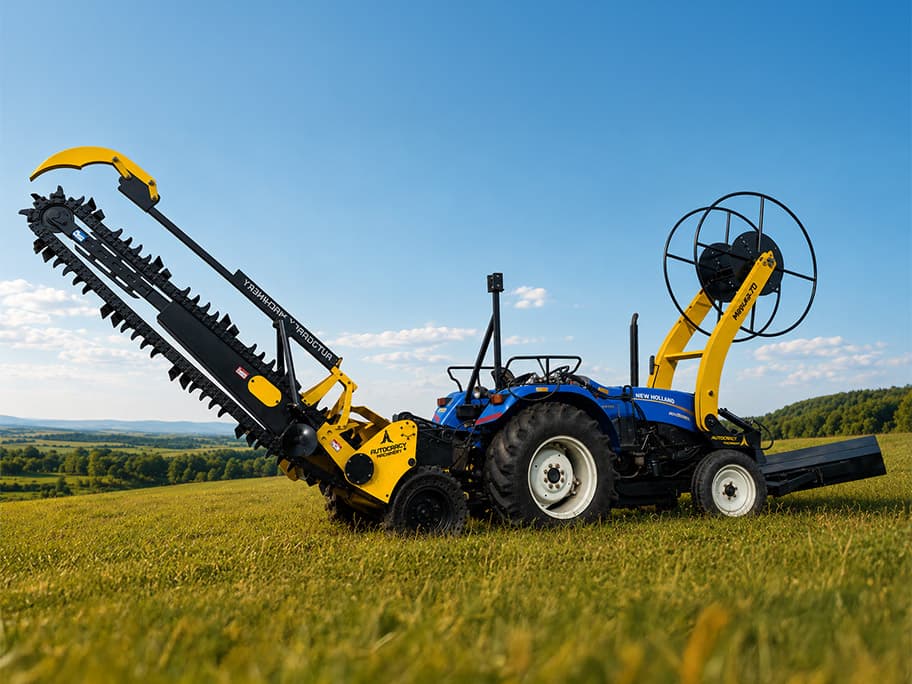
- | Equipment
Tractor
>60 HP
PTO / Hydraulic
300 m/hr (150 m/hr in soft soil, 90 m/hr in hard soil)
110–280 mm
Up to 1800 mm
30–60 mm
The Mayura TO is a tractor-mounted one-pass duct-laying solution designed for defence infrastructure projects requiring efficient deployment of underground communication and utility ducts. Its integrated chain trencher, front-mounted hydraulic decoiler, and 2-plate dozer combine trenching, HDPE duct deployment, and backfilling into a coordinated operation. Compatible with tractors above 60 HP, the Mayura TO Agriculture Utility Tractor Attachment can create trenches up to 1800 mm deep and 110-280 mm wide. The integrated decoiler supports HDPE duct rolls up to 2000 mm OD, while the 2-plate dozer can backfill up to 2500 mm wide, allowing trenching, duct laying, and closure to progress as a single coordinated operation. The Mayura TO is designed for Indian defence projects where underground communication ducts and suitable utility routes need to be established across defence installations, strategic facilities, remote locations, and extended infrastructure corridors. Its one-pass configuration combines excavation, duct deployment, and backfilling, helping project teams streamline underground duct installation without requiring separate trenching and backfilling operations.
PROJECT EXECUTION
Defence
Defence installations require underground communication infrastructure connecting suitable operational, administrative, surveillance, and supporting facilities. The Mayura TO creates the trench, deploys the HDPE duct through its integrated decoiler, and backfills the route behind the operation, allowing these stages to progress as one coordinated process.
Long-distance communication infrastructure can require extended underground duct routes across defence facilities and strategic infrastructure corridors. With trenching speeds of up to 300 m/hr, the Mayura TO supports continuous progress along planned alignments, with actual productivity varying according to soil conditions.
Defence infrastructure may extend into remote locations where equipment mobility and simplified field deployment are important considerations. The tractor-mounted Mayura TO can be deployed using a compatible tractor above 60 HP, supporting suitable duct-laying work across remote and challenging project environments.
Defence facilities may require underground communication ducts connecting different buildings, infrastructure zones, and supporting systems. The Mayura TO supports the development of suitable underground duct routes while completing trenching, duct deployment, and backfilling in a coordinated operation.
Surveillance and monitoring systems may require protected underground communication connections between equipment locations and supporting facilities. The Mayura TO can support suitable duct routes for these systems by deploying HDPE ducts directly into prepared trenches and closing the route behind the installation.
Defence installations can also require underground routes for suitable electrical, drainage, and other utility infrastructure. The machine's adjustable trench width and deep trenching capability provide flexibility for suitable underground infrastructure applications.
Defence
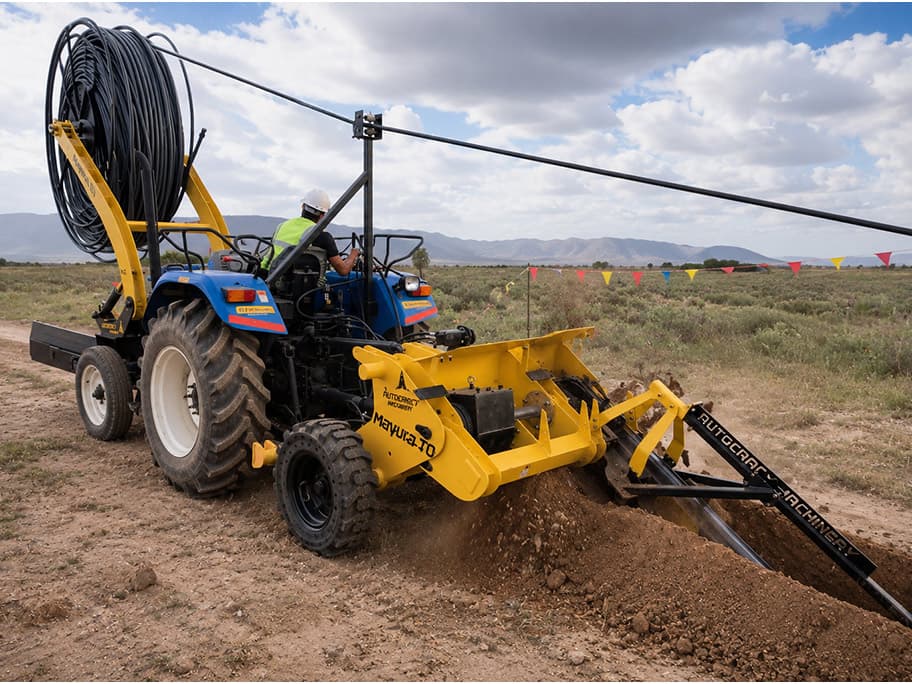
The Mayura TO combines trenching, HDPE duct deployment, and backfilling into one coordinated operation, reducing the need to execute these stages as separate activities.
The machine provides trenching depths of up to 1800 mm, supporting deeper underground duct and utility installation requirements.
Trench widths from 110-280 mm allow the trench profile to be selected according to the intended duct or utility installation requirements.
The front-mounted hydraulic decoiler supports continuous HDPE duct deployment and accommodates duct rolls up to 2000 mm OD and 600 mm in width.
The 2-plate dozer supports backfilling behind the duct-laying operation, with filling width capability from 1000-2500 mm and maximum backfilling depth of 2000 mm.
The Mayura TO operates with a single tractor above 60 HP, integrating trenching, duct deployment, and backfilling into one mobile machine configuration.
The specified maximum trenching speed is 300 m/hr, with approximately 150 m/hr in soft soil and 90 m/hr in hard soil, depending on field conditions.
The PTO / hydraulic transmission supports the machine's trenching, duct deployment, and backfilling functions during field operation.
The specified fuel consumption is 5-6 L/hr, supporting practical operation during extended infrastructure trenching and duct-laying activities.
WORKFLOW
Identify the communication or utility route, required trench dimensions, duct requirements, soil conditions, and site access before deploying the Mayura TO.
The chain trencher creates the planned trench while the front-mounted hydraulic decoiler deploys the HDPE duct directly into the trench as the machine advances.
The 2-plate dozer follows the duct deployment operation and backfills the route behind the machine, completing trench closure as part of the same pass.
The completed underground duct route can then be handed over for suitable cable installation, connection, protection, or subsequent defence infrastructure work.
APPLICATION SUPPORT
Share your site conditions, output goals, and timeline so the Autocracy team can guide model fit, brochure details, and next steps for your project.
Built for performance. Trusted by contractors, municipalities, and EPC teams across sectors.
| Feature | Value |
|---|---|
| ID of Duct roll (adjustable) | 850 mm (adjustable) |
| Width of Duct Roll | 600 mm |
| OD of Duct roll | Up to 2000 mm |
| Fuel Consumption Rate | 5–6 L/hr |
| Max Backfilling Depth: | 2000 mm |
| Max Blades Filling Width: | 2500 mm |
| Min Blades Filling Width: | 1000 mm |
| Overall Length: | 10500 mm |
| Overall Width: | 3200 mm |
| Overall Height: | 4500 mm |
Common questions about using Mayura TO in this application.
Industry model fit in India
For Defence deployment on India project sites, Mayura TO is considered when a equipment must handle remote work zones, restricted access areas, rugged terrain, and time-sensitive deployment sites. The model should be reviewed against route cutting, trench preparation, and utility corridor work where line accuracy matters, rugged reliability, transport readiness, field repairability, and predictable operation, and the way crews hand work over after each pass.
The first comparison for Mayura TO should be terrain type, access security, logistics, operator training, and rapid deployment windows, because those factors usually decide field fit before horsepower, headline capacity, or attachment choice.
Mayura TO can support camp utilities, boundary works, tactical infrastructure, drainage, and remote service routes, depending on route condition, access, output target, operator workflow, and site support availability.
This model page is meant to support a more practical conversation about defence fit, brochure review, transport planning, deployment timing, and quote needs.
A better defence shortlist connects trench depth, trench width, spoil handling, route crossings, surface reinstatement, and carrier fit with remote work zones, restricted access areas, rugged terrain, and time-sensitive deployment sites, so Mayura TO is reviewed against the actual job sequence.


