


Route Planning
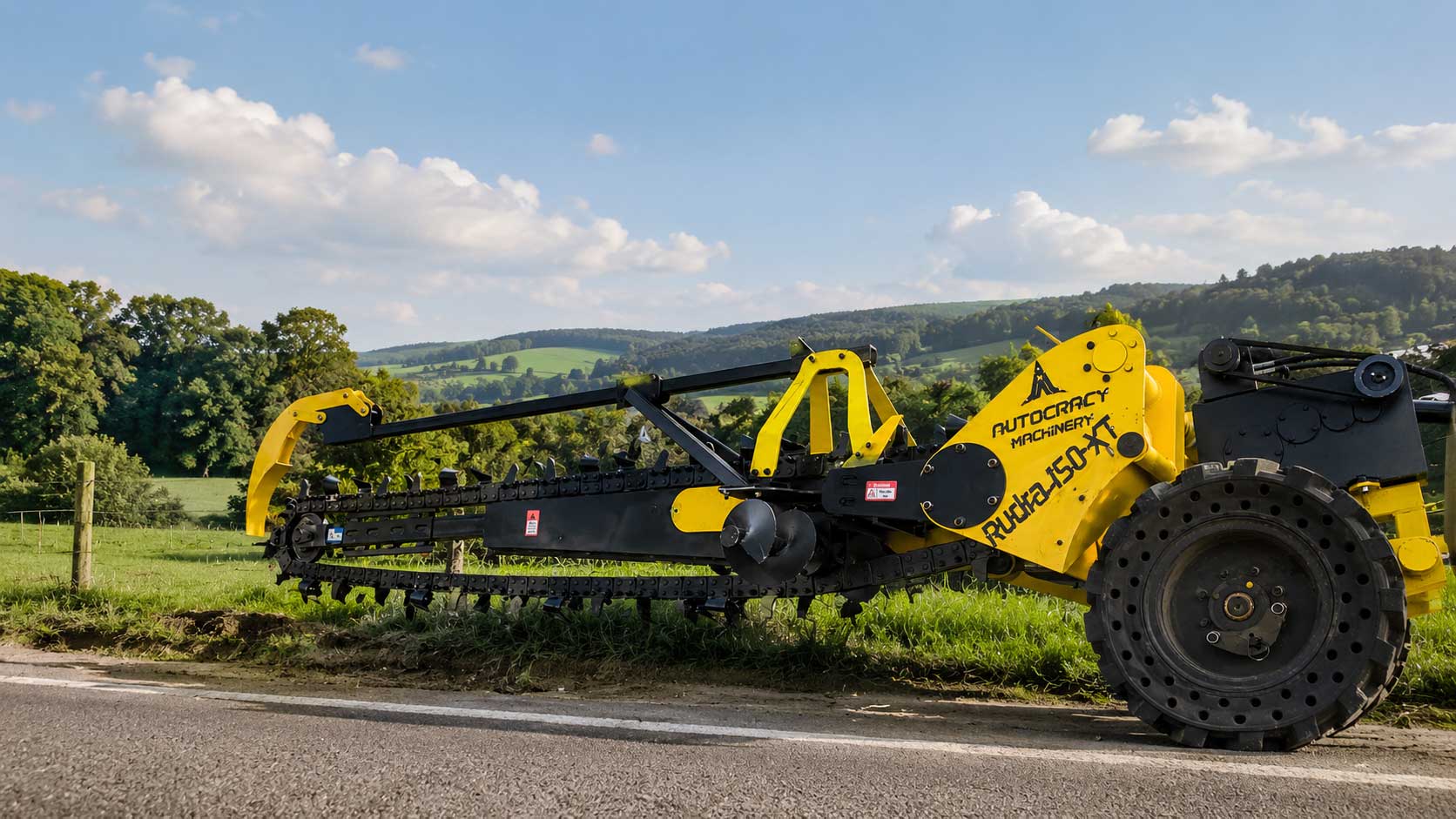
Map route requirements, trench depth, and site access before deploying Rudra 150XT.
- | Attachment
Tractor
>60 HP
PTO / Hydraulic
40 - 300m/hr (according to trench depth and soil condition)
110–280 mm
Up to 1800 mm
5–6 L/hr
Expanding fiber connectivity across India requires trenching equipment that can deliver depth, consistency, and speed under varying ground conditions. The Rudra 150XT is designed to support underground cable installation by creating clean and accurate trenches for optical fiber infrastructure with minimal surface disruption. Suitable for tractors above 60 HP, it helps contractors complete long-distance trenching efficiently while reducing dependence on manual excavation. As a Rudra 150XT OFC Cable Trencher in India, it is built to meet the demands of telecom and broadband infrastructure projects across urban, rural, and highway corridors.
PROJECT EXECUTION
OFC Telecommunications
The machine is widely used for laying optical fiber cables, HDPE ducts, telecom utility lines, and broadband network infrastructure. With adjustable trench widths and a digging depth of up to 1800 mm, it supports different project specifications while maintaining consistent trench quality.
The Rudra 150XT Cable Duct Trench Cutter Machine enables faster project execution, lower labour requirements, and reliable trench alignment, making it a practical solution for telecom contractors handling large-scale network expansion.
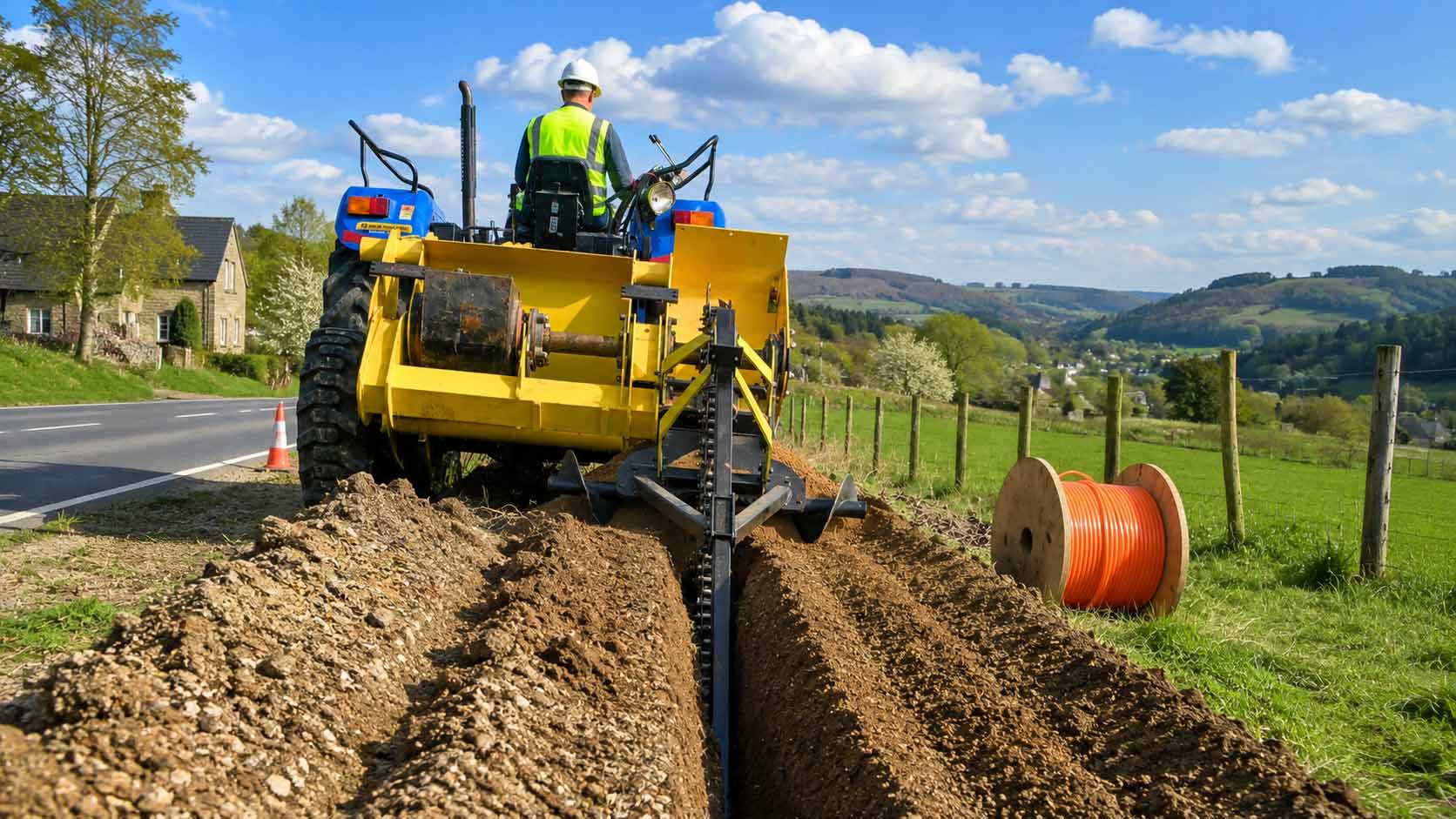
OFC Telecommunications
Powered through a PTO and hydraulic transmission system, the Rudra 150XT delivers stable trenching performance across soft, mixed, and moderately hard soil conditions.
Its controlled operation helps maintain uniform trench dimensions while keeping fuel consumption economical at 5–6 L/hr.
As a Rudra 150XT Telecom Utility Equipment in India, it improves productivity, reduces project delays, and supports timely completion of OFC installation projects with dependable field performance.
WORKFLOW
Map route requirements, trench depth, and site access before deploying Rudra 150XT.
Use the attachment setup to keep trench output consistent across rural, semi-urban, and last-mile utility corridors.
Cleaner trench profiles help duct laying, cable pulling, jointing, and surface restoration teams proceed with less rework.
Autocracy Machinery can help match machine configuration, brochure details, and application guidance to the project.
APPLICATION SUPPORT
Share your site conditions, output goals, and timeline so the Autocracy team can guide model fit, brochure details, and next steps for your project.
Built for performance. Trusted by contractors, municipalities, and EPC teams across sectors.
| Feature | Value |
|---|---|
| Gross weight | 2100 kg |
| Overall length | 5.63 m |
| Overall width | 2.3 m |
| Overall height | 1.52 m |
Common questions about using Rudra 150XT in this application.
| Attachment

Industry model fit in India
Rudra 150XT is listed here for project teams in India planning ofc telecommunications work with trenchers. Selection should come down to carrier fit, operating method, right-of-way, duct depth, spoil handling, traffic interface, and crew sequencing, and whether the machine supports route accuracy, cable protection, trench consistency, and kilometre-level productivity.
For OFC Telecommunications work, compare Rudra 150XT against right-of-way, duct depth, spoil handling, traffic interface, and crew sequencing before finalising equipment deployment, because these details decide whether the machine fits the route, access, and daily output target.
Rudra 150XT may suit OFC cable laying, telecom ducts, utility corridors, broadband rollout, and city network expansion when access, output goals, support arrangements, and follow-on crews line up with the job.
Use the page to move from specification review into a clearer discussion about ofc telecommunications suitability, brochure details, field support, and quotation requirements.
For trenchers, check trench depth, trench width, spoil handling, route crossings, surface reinstatement, and carrier fit together with road shoulders, urban corridors, utility crossings, and long linear cable routes; this helps separate a suitable ofc telecommunications setup from a generic model match.


