


Route Planning
Map route requirements, trench depth, and site access before deploying Mayura TO.
Mayura TO | Equipment
Tractor
>60 HP
PTO / Hydraulic
300 m/hr (150 m/hr in soft soil, 90 m/hr in hard soil)
110–280 mm
Up to 1800 mm
30–60 mm
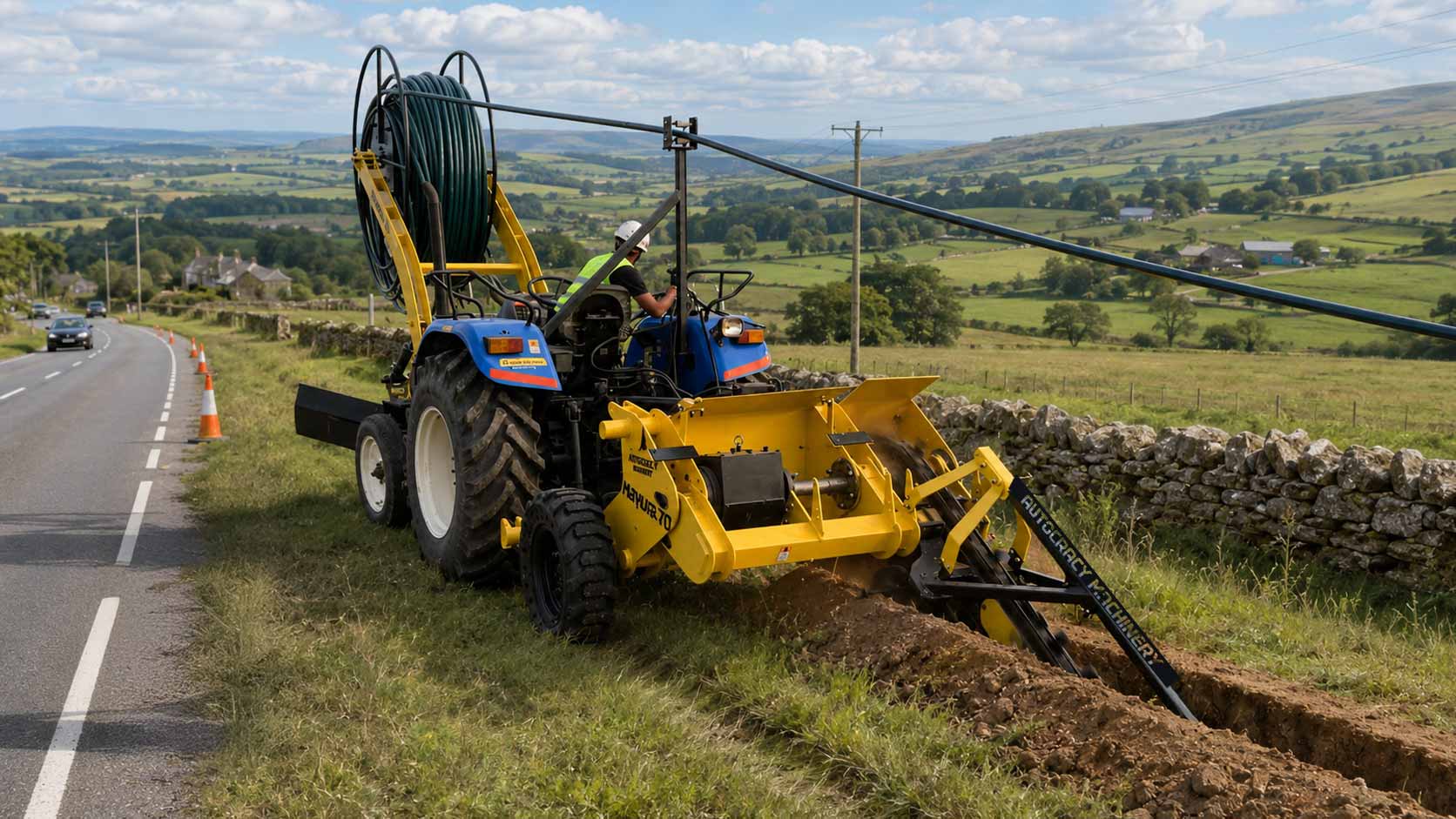
Fiber rollout projects often slow down not because of trenching itself but due to the gaps between excavation, duct placement, and restoration. The Mayura TO Cable Laying Trencher in India is built to remove these gaps entirely by turning three separate site activities into one continuous workflow. Instead of treating trenching and duct laying as independent tasks, this Mayura TO Trencher for OFC approaches the route as a moving installation line. As it progresses, the trench is created, the duct is positioned immediately, and the surface is restored right behind it, keeping the alignment active and completed in real time. This approach is particularly valuable in large-scale fiber programs where coordination between teams typically becomes the bottleneck. With Mayura TO, the dependency on multiple crews and staggered scheduling is minimized, allowing contractors to maintain steady forward movement along the route. It is especially effective in projects where long stretches must be completed quickly without leaving open trenches, such as roadside deployments, rural connectivity corridors, and time-sensitive telecom expansions. It ensures continuous progress without interruptions.
PROJECT EXECUTION
OFC Telecommunications
Mayura TO is best suited for projects where uninterrupted workflow is more critical than isolated machine performance.
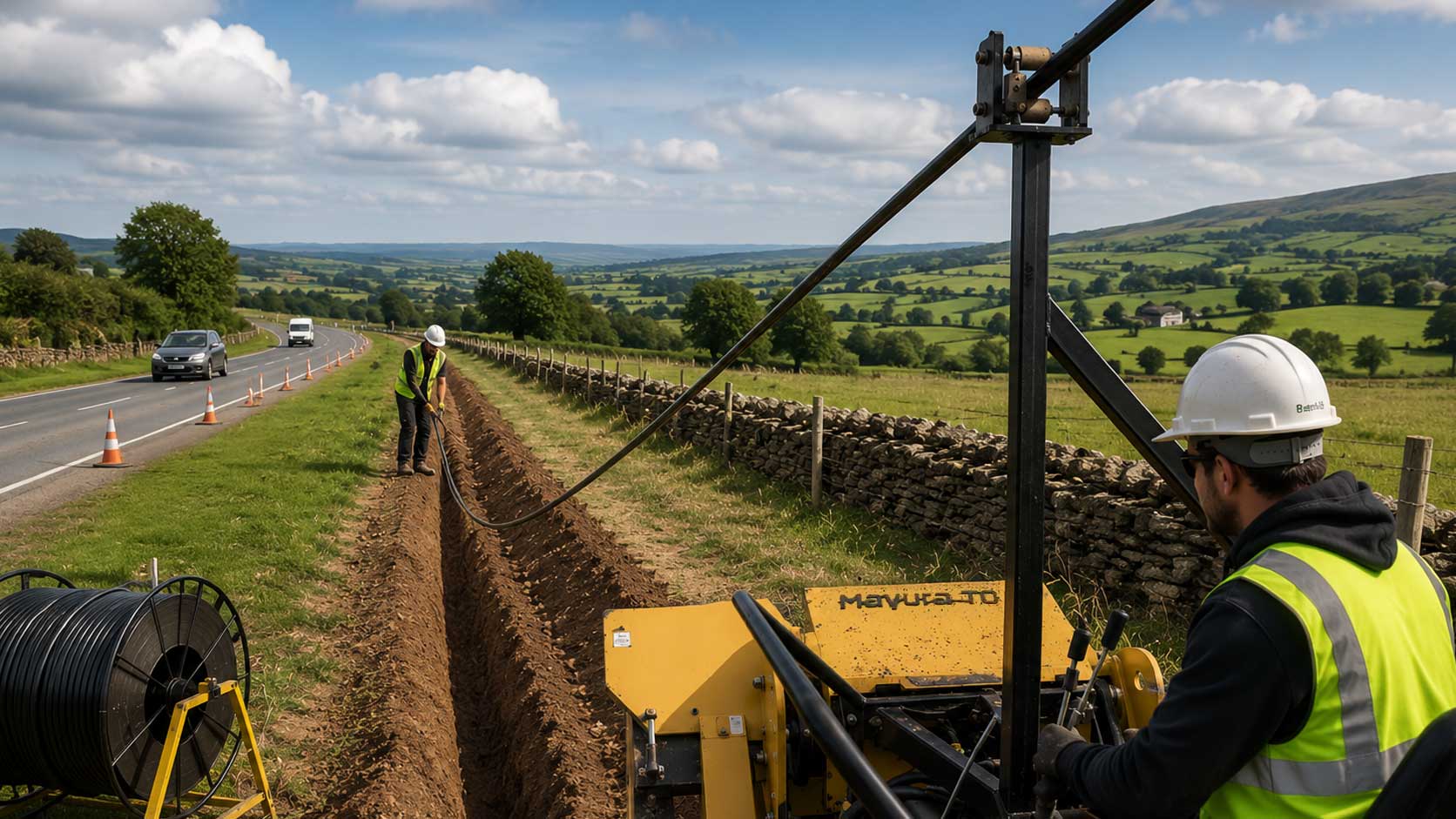
In optical fiber deployment, it supports full-route execution where ducts need to be installed continuously without repeated site handling. This makes it ideal for national fiber programs, highway-based cable laying, and dense rollout zones where efficiency per kilometer is the priority. The Mayura TO telecom infrastructure trench equipment plays a key role in enabling this seamless execution.
The machine also adapts well to utility corridors where multiple services share the same alignment. In such environments, reducing repeated excavation cycles becomes important, and a one-pass system helps avoid unnecessary ground disturbance.
Beyond telecom, it fits into projects involving pipeline placement, drainage channels, and underground electrical networks, especially where linear infrastructure must be delivered quickly and consistently.
OFC Telecommunications
The key shift Mayura TO introduces is workflow continuity. In traditional setups, each stage introduces delays, alignment risks, and additional handling. This machine removes those breaks by synchronizing all operations into a single progression, making it a reliable Mayura TO OFC Utility Channel Cutting Machine for modern telecom projects.
Another critical factor is site control. Since ducts are placed immediately after trench creation, there is minimal exposure time, reducing the chances of collapse, misalignment, or external interference.
Speed is not just about trenching rate, it’s about completion rate per route. By finishing the trench in the same pass, the machine ensures that each meter covered is also installation-ready, reducing rework and follow-up operations.
Operational simplicity is also improved. With a single tractor setup, contractors can reduce equipment coordination challenges, making the process more predictable and easier to manage across long distances. This also positions it as a Mayura TO Heavy Duty Cable Laying Trencher for demanding field conditions.
WORKFLOW
Map route requirements, trench depth, and site access before deploying Mayura TO.
Use the attachment setup to keep trench output consistent across rural, semi-urban, and last-mile utility corridors.
Cleaner trench profiles help duct laying, cable pulling, jointing, and surface restoration teams proceed with less rework.
Autocracy Machinery can help match machine configuration, brochure details, and application guidance to the project.
APPLICATION SUPPORT
Share your site conditions, output goals, and timeline so the Autocracy team can guide model fit, brochure details, and next steps for your project.
Built for performance. Trusted by contractors, municipalities, and EPC teams across sectors.
| Feature | Value |
|---|---|
| ID of Duct roll (adjustable) | 850 mm (adjustable) |
| Width of Duct Roll | 600 mm |
| OD of Duct roll | Up to 2000 mm |
| Fuel Consumption Rate | 5–6 L/hr |
| Max Backfilling Depth: | 2000 mm |
| Max Blades Filling Width: | 2500 mm |
| Min Blades Filling Width: | 1000 mm |
| Overall Length: | 10500 mm |
| Overall Width: | 3200 mm |
| Overall Height: | 4500 mm |
Common questions about using Mayura TO in this application.
Industry model fit in India
Mayura TO Mayura TO is presented for OFC Telecommunications applications on India project sites, where a equipment has to work around road shoulders, urban corridors, utility crossings, and long linear cable routes. This page adds india-focused context for trenchers, so teams can judge whether the model supports route accuracy, cable protection, trench consistency, and kilometre-level productivity.
Start by checking Mayura TO against right-of-way, duct depth, spoil handling, traffic interface, and crew sequencing; that route-specific review is more useful than treating every trenchers page as the same model brochure.
Common ofc telecommunications use cases for Mayura TO include OFC cable laying, telecom ducts, utility corridors, broadband rollout, and city network expansion, provided the site setup supports the machine, crew movement, and next work stage properly.
Use this model page to discuss OFC Telecommunications fit, specification limits, transport readiness, brochure details, and quote requirements with Autocracy Machinery.
project teams in India should confirm soil condition, daily metres, trench profile, access width, and downstream installation speed before shortlisting Mayura TO, especially when road shoulders, urban corridors, utility crossings, and long linear cable routes affect access or productivity.


