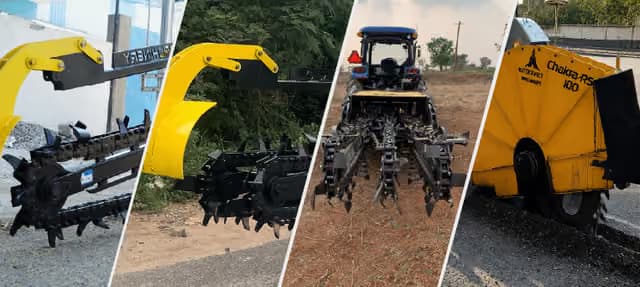
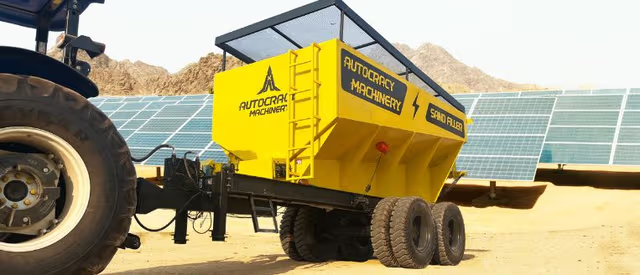
Trenching requirements can be very different based on what the project needs. Drip irrigation might need a narrow and even trench, but water pipelines, fiber optic cable installation, drainage systems, solar projects, and underground utilities might need trench depths and conditions.
Using conventional digging equipment for these applications can sometimes involve excavating more soil than the project actually requires. For long, defined routes, this can also make it more difficult to maintain a consistent trench width and depth throughout the work.
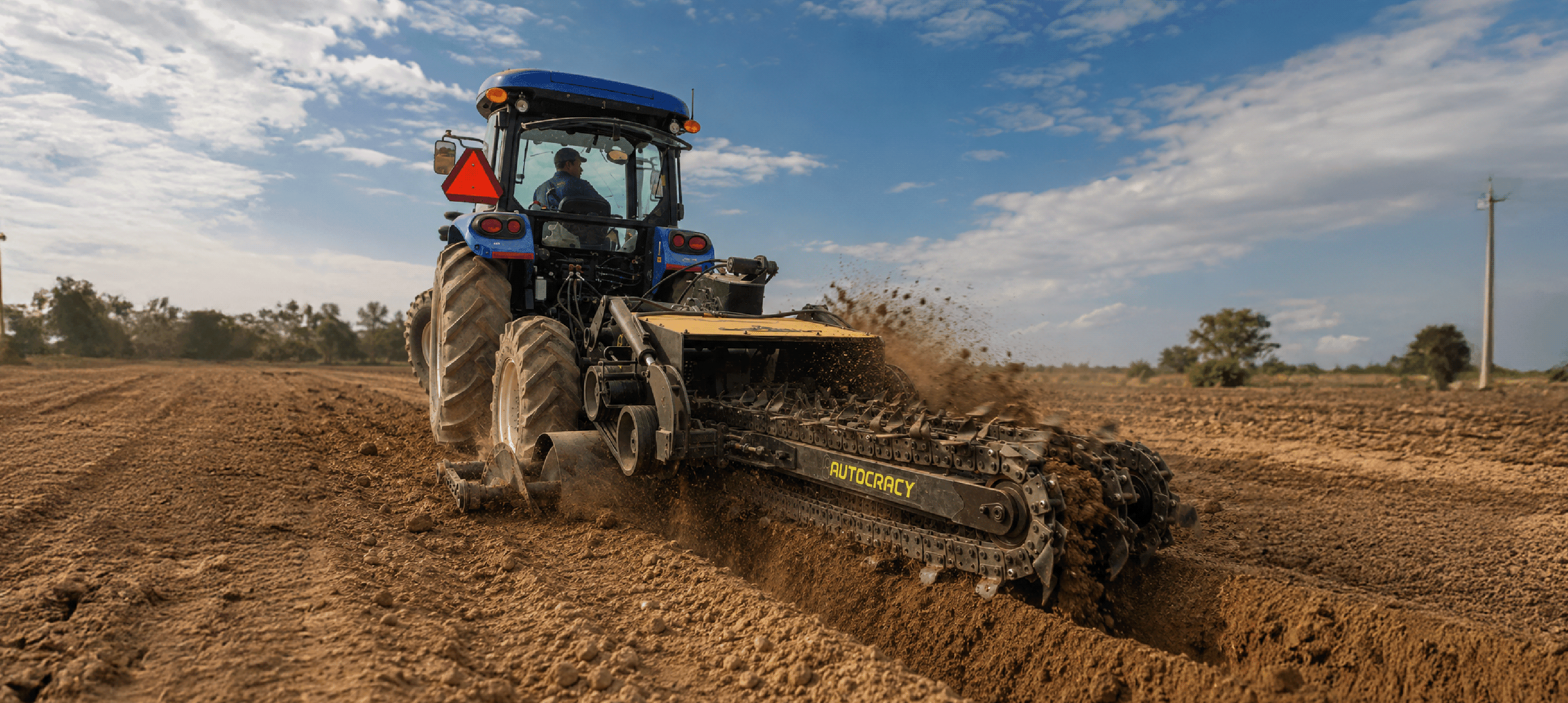
This is when a trencher that is made for the project can help. The Rudra 100XT Water Pipeline Trencher is a tractor-mounted trencher made for farming and building projects where making the right trench, working with tractors, and being efficient are important.
It is made for tractors that have more than 50 HP. The Rudra 100XT can dig trenches deep as 1200 mm and as wide as 110-280 mm. It has a PTO/hydraulic system. The machine can dig at a speed of 40-300 meters per hour. This lets the person running the machine adjust how fast it works based on how deep the trench.
Choosing a Trencher Based on Trench Dimensions
The Rudra 100XT Trenching Machine can dig trenches that are between 110 mm and 280 mm wide. It can go as deep as 1200 mm. This setup gives users a lot of flexibility, especially when the job needs a trench but one that goes deeper.
For instance, irrigation pipelines often need digging. Drip irrigation systems also work better with controlled trench shapes. The same goes for laying fiber optic cables or installing utility lines. In these cases a broad excavation is not needed. A clean narrow trench works better.
The Rudra 100XT Trencher Equipment is designed to operate with tractors above 50 HP and uses a PTO/hydraulic transmission system. This configuration supports power delivery from the tractor to the trenching system while allowing the machine to be integrated into tractor-based field operations.
For agricultural and infrastructure contractors, this can help simplify equipment planning by considering the tractor and trencher as part of the same operating setup.
The machine is particularly suited to rural roads, agricultural fields, and compact work sites where trenching needs to be performed along defined routes.
Trenching Speed According to Soil and Depth
Trenching productivity can vary depending on ground conditions and the required trench depth. The Rudra 100XT Tractor Trencher for Water Pipeline supports a trenching speed range of 40-300 m/hr, depending on trench depth and soil conditions.
Under the stated operating conditions the machine can achieve a trenching speed of about 280 to 300 meters per hour in soil. In soil the speed drops to around 150 to 200 meters per hour.
Fuel Consumption and Operating Efficiency
Another factor when choosing trenching equipment for field use is fuel consumption.
The Rudra 100XT Trencher for Water Pipeline uses between 5 and 6 liters of fuel per hour. This fuel rate is helpful when planning projects, especially since the machine is mounted on a tractor and has known trenching capabilities.
Actual operating requirements can vary according to soil conditions, trench depth, working speed, tractor configuration, and site conditions.
Where Can the Rudra 100XT Be Used?
The Rudra 100XT is designed for a range of agriculture, infrastructure, and underground utility applications.
Agriculture
In agriculture, trenching is often required for irrigation infrastructure and farm utilities. The Rudra 100XT supports applications such as drip irrigation pipelines, irrigation systems, drainage channels, farm utility installations, agricultural water management
Its trenching depth of up to 1200 mm and width range of 110-280 mm allow operators to consider different trench profiles according to the project requirement.
Water Management
Water management projects often involve pipelines, irrigation routes, and drainage systems. These projects need excavation to ensure the proper placement of infrastructure. It is designed to support trenching for irrigation pipelines, drainage setups, and underground utility installations. It offers performance in situations where controlled route-based digging is essential.
Construction and Infrastructure
In construction work trenches are commonly needed for utility lines, pipelines, electrical ducts, and other underground structures. The Rudra 100XT delivers a trenching solution with adjustable trench widths ranging from 110 mm to 280 mm and depths up to 1200 mm. This makes it well-suited for a variety of infrastructure applications requiring efficient trenching.
Energy Projects
Energy infrastructure can involve extensive underground cable and utility routes. The Rudra 100XT can be used for trenching applications associated with solar, wind, and power transmission projects, particularly where underground cable or utility installation is required.
Defence and Utility Infrastructure
Underground communication lines, cables, drainage systems, and utility infrastructure can also require controlled trenching. It can support these types of trenching requirements in defence and secured project areas, subject to site conditions and project specifications.
Fiber Optic Cable Laying
Fiber optic cable installation often requires a defined and consistent trench route. The Rudra 100XT is designed to support fiber optic cable laying, providing a trench width range of 110-280 mm and trench depths of up to 1200 mm for projects where these dimensions are appropriate.
Key Specifications of the Rudra 100XT
The main specifications of the Rudra 100XT include:
Specification Rudra 100XT
Support Vehicle Tractor
Horsepower Requirement >50 HP
Trench Depth Up to 1200 mm
Trench Width 110-280 mm
Transmission Type: PTO / Hydraulic
Trenching Speed: 40-300 m/hr
Speed in Soft Soil: 280-300 m/hr
Speed in Hard Soil: 150-200 m/hr
Fuel Consumption: 5-6 L/hr
Overall Length 4950 mm
Overall Width 2195 mm
Overall Height 1350 mm
Gross weight: 1900 kg
These specifications allow project teams to evaluate the Rudra 100XT according to the required trench profile, tractor availability, ground conditions, and application.
Matching the Rudra 100XT to Project Requirements
The selection of trenching equipment should begin with the project requirement rather than simply the machine name.
For projects requiring trench widths between 110 and 280 mm and depths up to 1200 mm, the Rudra 100XT provides a tractor-mounted configuration to consider.
Its compatibility with tractors above 50 HP, PTO/hydraulic transmission, and trenching speed range of 40-300 m/hr makes it suitable for evaluating applications across agriculture, water management, utilities, construction, energy, and infrastructure.
Conclusion
A trencher machine must be chosen based on the trench shape, the type of soil, the carrier, the use, and the needs of the project.
The Rudra 100XT is a tractor‑mounted trencher made for farming and infrastructure work. It can dig trenches as deep as 1200 mm, and its trench width can be changed from 110 mm to 280 mm. The Rudra 100XT works with tractors that have more than 50 horsepower, and it can cut trenches at speeds between 40 and 300 meters per hour. The Rudra 100XT offers a setup that fits road‑based trenching jobs.
The Rudra 100XT can be looked at for tasks such as drip irrigation, water pipelines, fiber‑optic cable laying, underground utilities, construction, energy projects, and water management. The machine works best when you need a steady trench.
FAQs
1. What is the Rudra 100XT used for?
It is a tractor-mounted trencher designed for applications such as drip irrigation, fiber optic cable laying, water pipeline trenching, underground utility installation, agriculture, construction, energy, and water management.
2. What tractor is required for the Rudra 100XT?
The machine is designed for tractors with a horsepower rating of above 50 HP.
3. What is the maximum trench depth of the Rudra 100XT?
It supports trenching depths of up to 1200 mm.
4. What trench width does the Rudra 100XT support?
The machine supports trench widths from 110-280 mm, allowing operators to consider different trench profiles according to the application.
5. What is the trenching speed of the Rudra 100XT?
It has a trenching speed range of 40-300 m/hr, depending on trench depth and soil conditions. The stated operating speeds are approximately 280-300 m/hr in soft soil and 150-200 m/hr in hard soil.
6. What type of transmission does the Rudra 100XT use?
The machine uses a PTO/hydraulic transmission system.
7. What is the fuel consumption of the Rudra 100XT?
The stated fuel consumption rate is 5-6 L/hr.
8. Is the Rudra 100XT suitable for agriculture?
Yes, it is designed for agricultural applications, including drip irrigation, irrigation pipelines, drainage, and farm utility installations.
9. Can the Rudra 100XT be used for fiber optic cable laying?
Yes, fiber optic cable laying is one of the intended applications of the Rudra 100XT, subject to the required trench dimensions and site conditions.
10. What should be considered before selecting the Rudra 100XT?
Project teams should consider the required trench width and depth, soil conditions, route requirements, tractor compatibility, site access, required output, and the specific application before deployment.