Route Planning
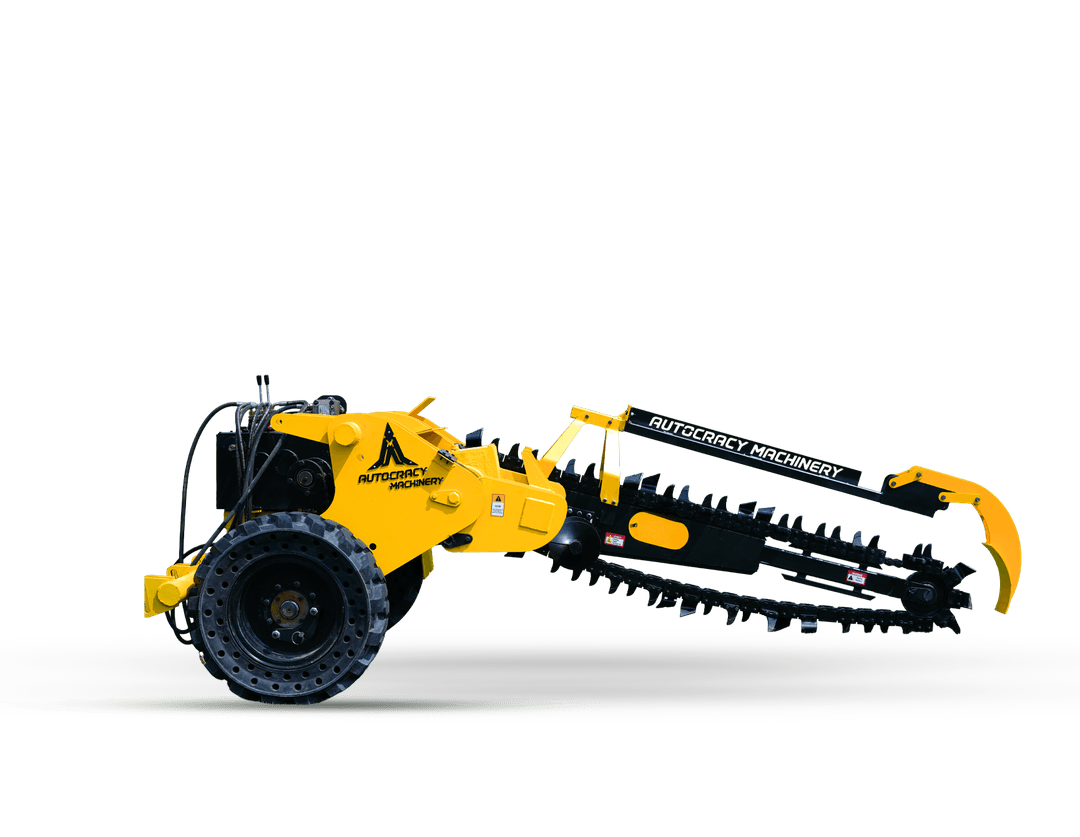
Map route requirements, trench depth, and site access before deploying Rudra 100.
- | Attachment
>50 HP
PTO / Hydraulic
280–300 m/hr in soft soil and 200–220 m/hr in hard soil.
110–280 mm
Up to 1000 mm
5-6 L/hr
1200 kg
In modern farming, trenching plays an important role in improving field organisation, supporting soil structure, and enabling better land preparation. The Rudra 100 Agriculture Trencher is designed to meet these on-ground agricultural needs with a practical approach suited to real farm conditions rather than controlled environments.
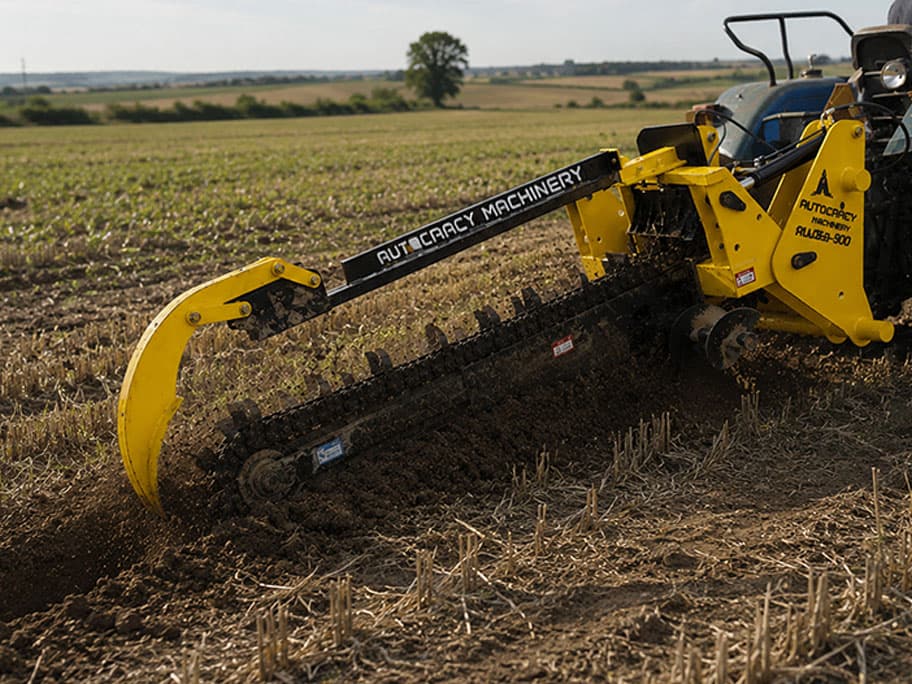
The Rudra 100 operates as a tractor-mounted solution that integrates directly into existing agricultural workflows. This makes it particularly useful for farmers and contractors who need to carry out repeated trenching activities across fields without disrupting routine operations.
From laying irrigation pipelines to creating drainage channels that prevent waterlogging, the machine supports consistent trench quality while maintaining soil structure around the working area. Its ability to operate across uneven farmland, soft soil, and semi-prepared ground ensures that trenching can continue even in variable field conditions. This helps reduce project delays and enables better planning of seasonal agricultural activities.
PROJECT EXECUTION
Agriculture
Agricultural trenching is rarely confined to a single task. It often involves a combination of irrigation setup, water management, and basic infrastructure development within and around farmlands. The Rudra 100 Modern Farm Trenching Equipment is built to handle these needs in a way that aligns with practical farm usage.
In farms with varying soil conditions and terrain, the equipment helps maintain workable field conditions by supporting structured ground preparation where needed. Its role extends to enabling smoother execution of on-field activities without disrupting existing crop zones or soil balance.
The compact design allows it to move easily through narrow farm access paths and operate efficiently across different sections of farmland. For operators working across multiple fields, this flexibility reduces dependency on additional machinery while improving overall efficiency in day-to-day agricultural operations.

Agriculture
Effective trenching in agriculture is not just about digging; it requires precision, timing, and minimal disturbance to productive land. The Rudra 100 Agriculture Land Preparation Machine supports this by enabling controlled trenching with stable depth consistency.
The machine addresses these challenges by enabling controlled trenching with stable depth management, allowing operators to maintain uniformity across long stretches of farmland. This is particularly important when installing irrigation systems where even minor inconsistencies can lead to uneven water distribution.
Another key priority in farm operations is minimizing idle time. Since the equipment works with standard tractors, deployment is quick and does not require additional setup or specialised transport. This allows trenching activities to be completed within tight agricultural timelines, especially during pre-sowing or field preparation stages. By improving trenching speed and consistency while reducing manual effort, the Rudra 100 supports better resource planning and enhances overall farm productivity.
WORKFLOW
Map route requirements, trench depth, and site access before deploying Rudra 100.
Use the attachment setup to keep trench output consistent across farm lanes, park areas, plantation rows, and narrow landscaped spaces.
Cleaner trench profiles help pipe placement, sprinkler installation, drainage, and landscape reinstatement teams proceed with less rework.
Autocracy Machinery can help match machine configuration, brochure details, and application guidance to the project.
APPLICATION SUPPORT
Share your site conditions, output goals, and timeline so the Autocracy team can guide model fit, brochure details, and next steps for your project.
Built for performance. Trusted by contractors, municipalities, and EPC teams across sectors.
| Feature | Value |
|---|---|
| Overall Length | 3.99 m |
| Overall Width | 1.42 m |
| Overall Height | 1.14 m |
Common questions about using Rudra 100 in this application.
Industry model fit in India
For Agriculture deployment on India project sites, Rudra 100 is considered when a attachment must handle farm tracks, irrigation routes, plantation rows, and seasonal soil windows. The model should be reviewed against route cutting, trench preparation, and utility corridor work where line accuracy matters, crop safety, narrow access, low disturbance, and dependable daily output, and the way crews hand work over after each pass.
The first comparison for Rudra 100 should be row spacing, soil moisture, trench depth, tractor availability, and harvest calendar constraints, because those factors usually decide field fit before horsepower, headline capacity, or attachment choice.
Rudra 100 can support irrigation lines, farm utilities, plantation support, fencing, and rural water movement, depending on route condition, access, output target, operator workflow, and site support availability.
This model page is meant to support a more practical conversation about agriculture fit, brochure review, transport planning, deployment timing, and quote needs.
A better agriculture shortlist connects trench depth, trench width, spoil handling, route crossings, surface reinstatement, and carrier fit with farm tracks, irrigation routes, plantation rows, and seasonal soil windows, so Rudra 100 is reviewed against the actual job sequence.